




kimhutton.
A doorway for the curious. A destination for enthusiasts. A relationship engine for Heineken Beverages.
Client: Distell, now Heineken BeveragesBrands: Bain’s · Three Ships · James Sedgwick DistilleryRole: Senior Digital Insights ManagerFocus: Brand strategy · Positioning · Customer experience · Membership strategy · Audience segmentation · CRM · Go-to-marketScope: South AfricaProof: 4,852 unique visitors in 48 hours · 832 sign-ups · 20% conversion rate
Career impact: Promotion to Senior Brand Strategist across Hoorah Group’s portfolio and Heineken Beverages.
Context
The Centre of Intelligence team I led — six direct reports and myself — had just delivered a Spirits Consumer Trends & Forecast report: threats, opportunities and market signals across the category.
Buried in it was a problem: whisky had the lowest popularity and the lowest related conversation of any spirit among younger audiences.
The reason was not taste. It was perception.
Whisky felt elitist. Exclusive. A dim-lit mahogany bar, leather wingbacks and polished shoes — that was the “vibe” people associated with the category, and it was the single most commonly cited negative sentiment around whisky in the data.
As the Insights Manager, I identified the whitespace: if whisky wanted to appeal to younger audiences, it needed to tackle that perception head-on, with education, confidence-building and nurturing. Done correctly, it could become a genuine long-term asset for the company.
“Like a whisky club, for example.”
Whisky Club Brief:
Develop a whisky club for Bain's, Three Ships and James Sedgwick Distillery that could:
I owned everything that followed — research, brand architecture, positioning, segmentation, UX, GTM — end to end.
The whisky paradox
Whisky drinking was never just about the liquid. It was about the experience around it — shaped by how people felt while participating, and how they believed they would be perceived for taking part. Whisky was a social signal.
Every whisky club in South Africa at the time leaned hard into the elitist cigar-lounge aesthetic. Surprisingly, audience research showed that people who already liked whisky often appreciated that lifestyle. The premium world, the ritual, the taste cues and the codes of sophistication were not irrelevant. They were part of the appeal.
The problem was that premium often felt closed.
The data pointed to where: audiences were already drinking whisky in non-traditional ways. Cocktails were popular both on- and off-trade. Yet every competitor still positioned whisky in a purist fashion, gatekeeping the very behaviour that could grow the category — an untapped market hiding in plain sight, and proof that lowering the barrier to entry from purists-only to curious cocktail drinkers wasn't sacrilege, if done right.
That meant the premium codes couldn't be discarded — they needed reinterpreting. Not stripped of sophistication, but re-rooted in something distinctly South African: the natural ingredients shaped by the African sun, the pioneering distilleries, the craft of a whisky industry still writing its own story. A naturally local sophistication, rather than the imported, imitative elitism that had defined the category until now.
The Challenge
Make exclusivity feel like an invitation rather than a restriction.The premium, members-only quality that made whisky desirable had to remain — but it had to be opened up, so that curiosity, not expertise, was the price of entry. Get that balance wrong in either direction and the brand either loses its appeal or re-erects the same barrier it set out to remove.
The Opportunity
Shift the signal — from elitist and intimidating to confident, curious and culturally desirable. Creating a membership experience that could open up the category while protecting what made whisky feel worth joining in the first place.
The Whitespace
Creating a new premium [South African] code - a way to make whisky feel confident, curious and culturally desirable — without making it feel less premium.
Imported Elitism
Dark rooms · expertise anxiety · purist rules · exclusion
Naturally local sophistication
South African sun · local craft · pioneering distilleries · confidence through pride

Every thread of research — competitor, category, and macro-environment — kept returning to the same term: South African.
All three partner brands already carried local craft and heritage independently, and “support local” was a rising cultural tide across South Africa.
That gave the strategy credible common ground.
It also gave the Society a way to solve the whisky paradox without stripping the category of its premium appeal.
South African whisky could create a different kind of sophistication: one rooted in local craft, natural ingredients shaped by the African sun, pioneering distilleries, and an industry still writing its own story.
Being seen supporting a South African whisky club immediately lowered the cognitive load of joining.
Participation no longer felt like stepping into an intimidating circle of experts. It felt like backing something proudly local, alongside everyone else doing the same.
The vision: A society that leads the South African whisky revolution. Aiming to unite whisky lovers and together explore, and develop, the South African Whisky Culture.
From insight to brand
What I needed to solve:
How do we build one Society that three distinct whisky brands could credibly belong to, without flattening their equity, favouring one product, or creating internal competition?
Method: Synthesis. I needed to find what elements of each brand crossed over but still maintained their own identity. I worked from each brand’s existing strategy, product role and ambition, but prioritised where the brands were trying to go over what their documents had historically said.
On a product level, Bain’s and Three Ships both had strong product portfolios, loyal audiences and some natural overlap between products, but then James Sedgwick Distillery was just a distillery. Without a product hat in the ring, James Sedgwick was the ‘neutral party’ from a competitor perspective, but it did provide a level of authority on craft, the process and distilleries. A vital reason to believe for this audience. So, JSD would be the brand home of this Whiskey Club. They would need to do the heavy lifting for the in-person experiences and collaborations with other whiskey distillers / voices of authority, for credibility. as well as provide the experiences and craft to the club.
Bain’s was widely known for its premium pedigree, and Three Ships were shooting for the same audience. Their brand approaches were pretty different though, which gave me a bit of room to work. I found that Three Ships was appreciated by their audiences for their ‘South Africanacity’, but their audience was whiskey-mixers and people new to whiskey, whereas the conoisseurs were behind Bain’s for their pedigree.
The common ground they all had, that was not competitive territory, was being proudly South African.
The solve:How does each brand contribute to South African Whisky Culture?


Category Differentiators
Makers & Process
Distillery authority
Craft authority
Reason to Believe
Brand Role
within Dash & Dram
South African quality
Grounded ingenuity
Quality benchmark
Premium pedigree
Mastery, remastered
Pedigree standard


A shared platform for South African whisky culture

Together, they created a brand system that could hold product, education, access, experience and national pride without making any one bottle the hero.
Brand DNA
Positioning
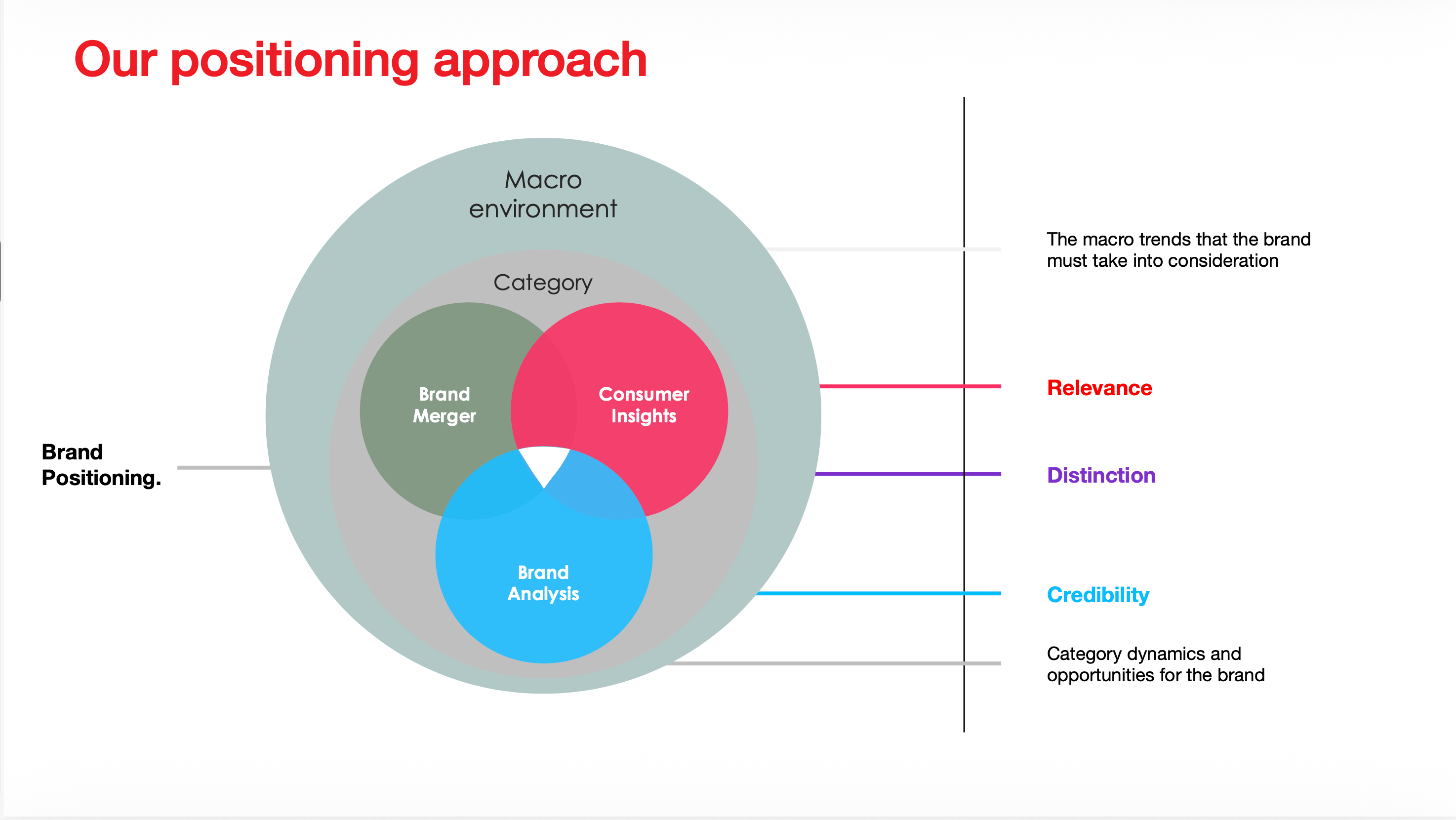
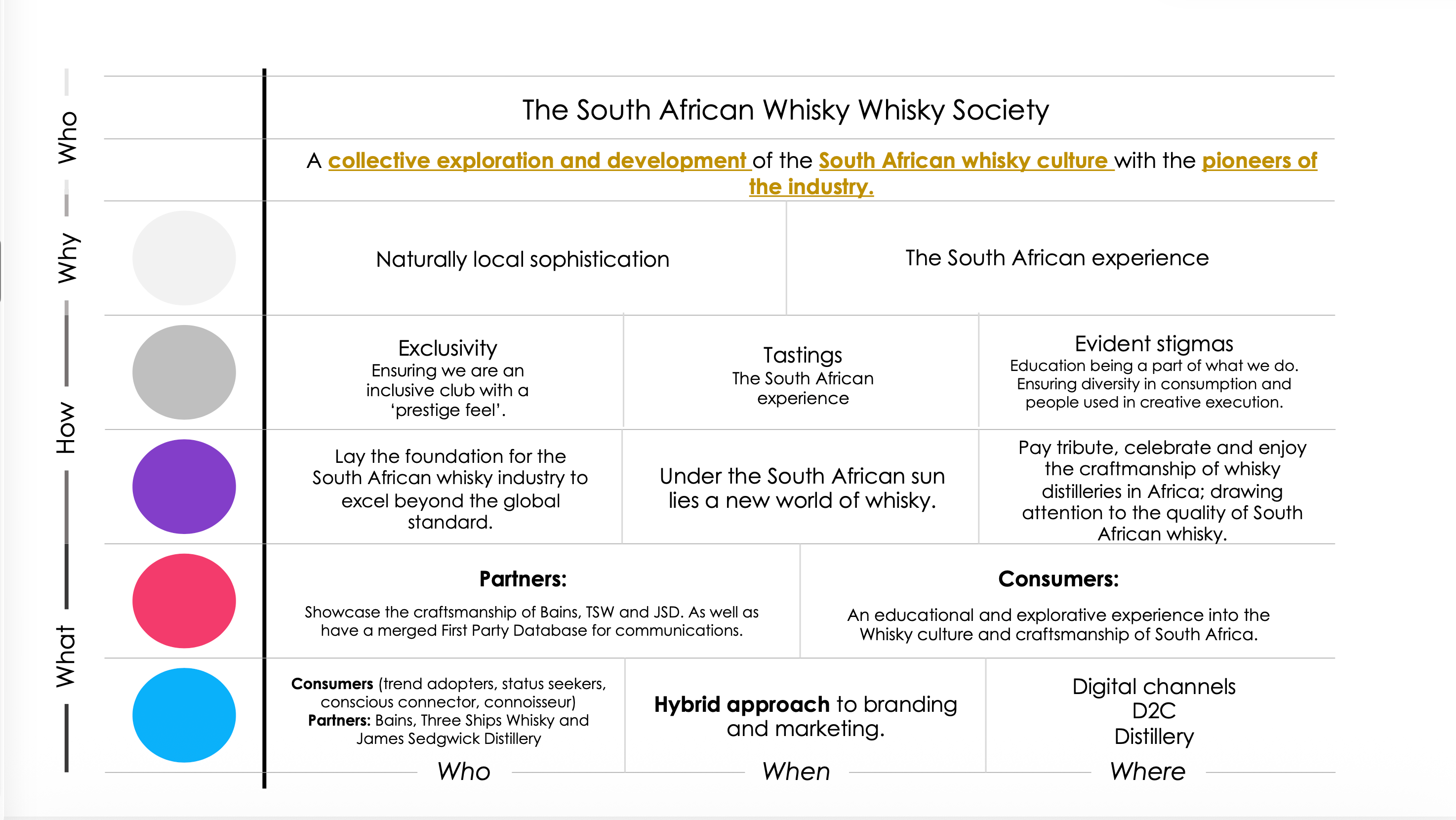
Consumer Insights
Brand Analysis
The brand architecture clarified what the Society could credibly hold. The next question was what it should make people feel part of.
I mapped three positioning territories on a functional-to-emotional spectrum: Exploration, Revolution and Celebration.
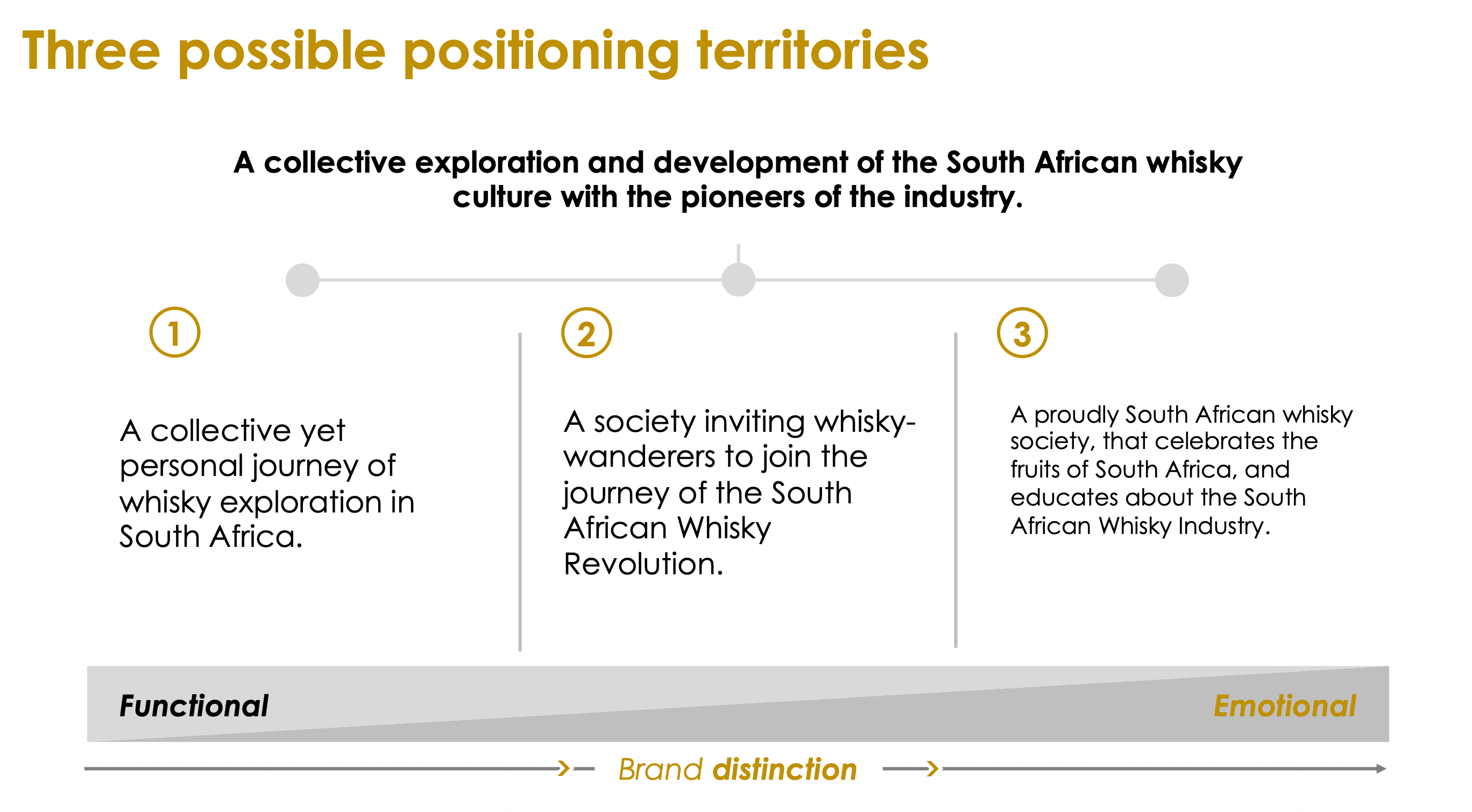
Exploration was the most accessible territory. It gave curious drinkers permission to learn, taste and discover without needing to perform expertise. But on its own, it felt too functional — more tasting guide than cultural movement.
Celebration was the most emotionally obvious. It leaned into South African pride, local craft and national identity. But it risked narrowing the Society to people already motivated by localism, rather than inviting people who were simply curious about what whisky could become.
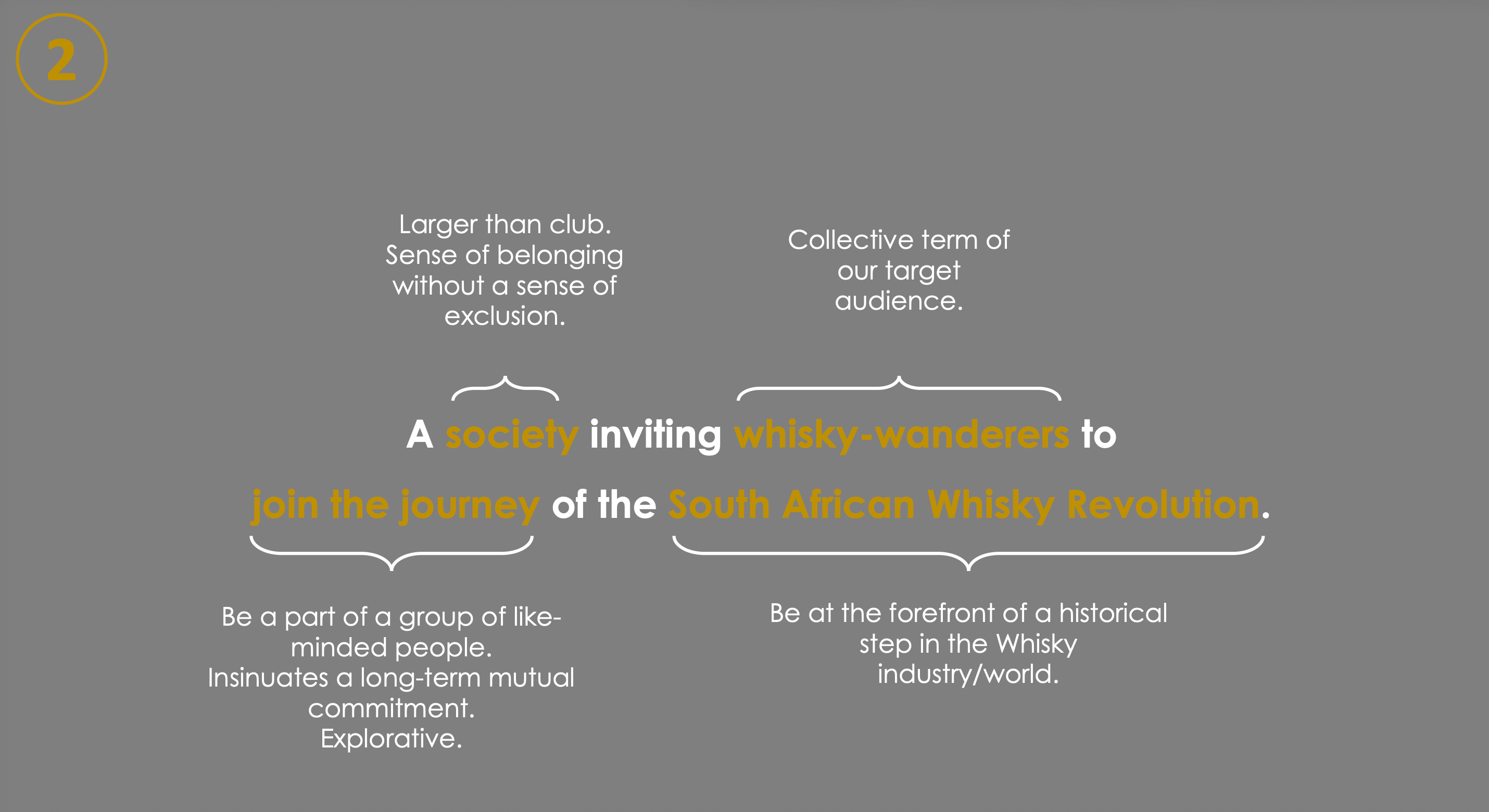
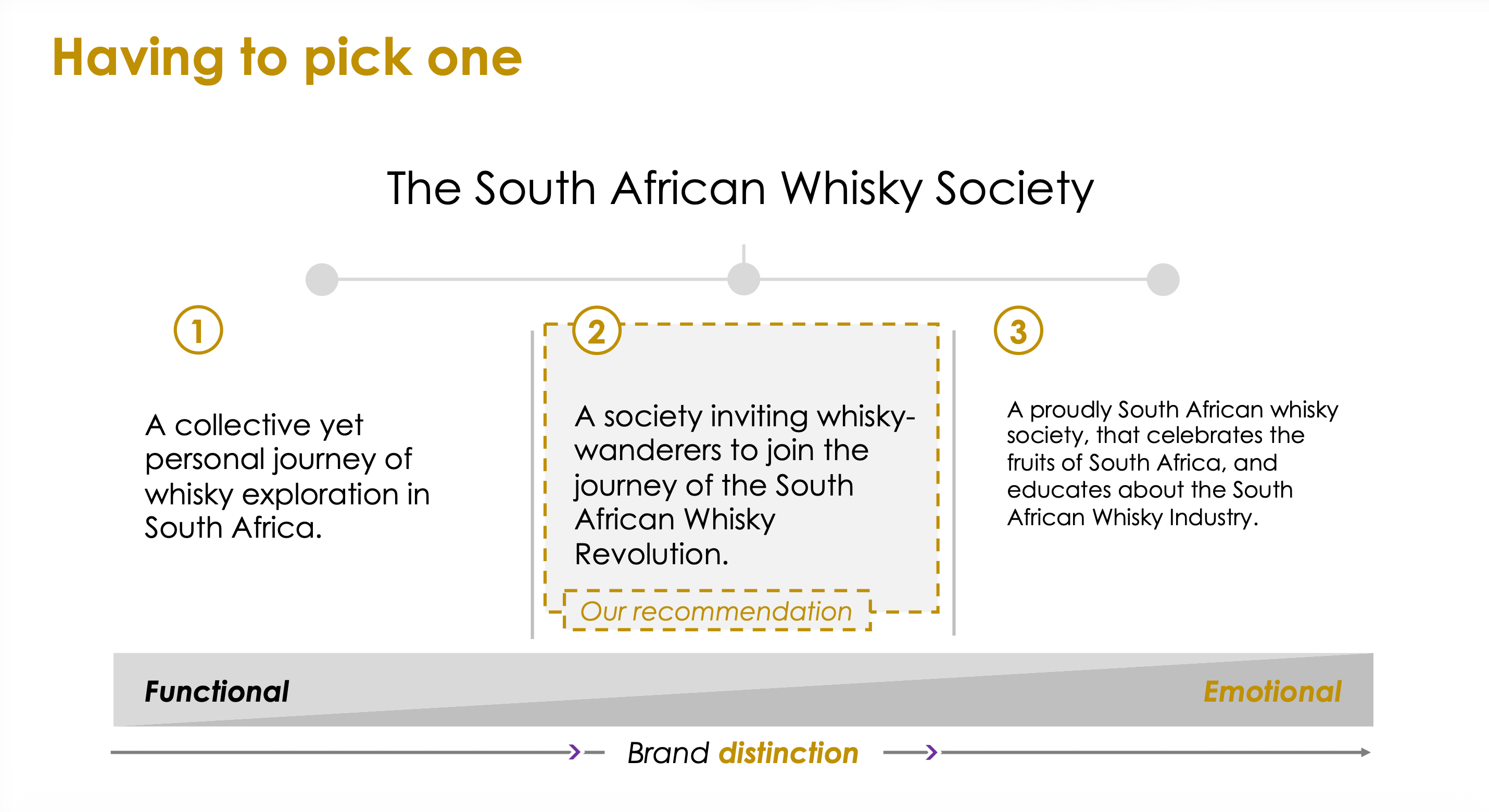
Revolution gave the Society the strongest middle ground. It held the ambition of the category shift without making the brand feel aggressive or exclusionary. It positioned South African whisky as something gathering momentum: a category with its own makers, codes, confidence and cultural energy.
That territory also gave the audience a more inviting role.
They did not need to arrive as experts. They could arrive as whisky-wanderers: curious, open, socially engaged and willing to discover the category as it evolved.
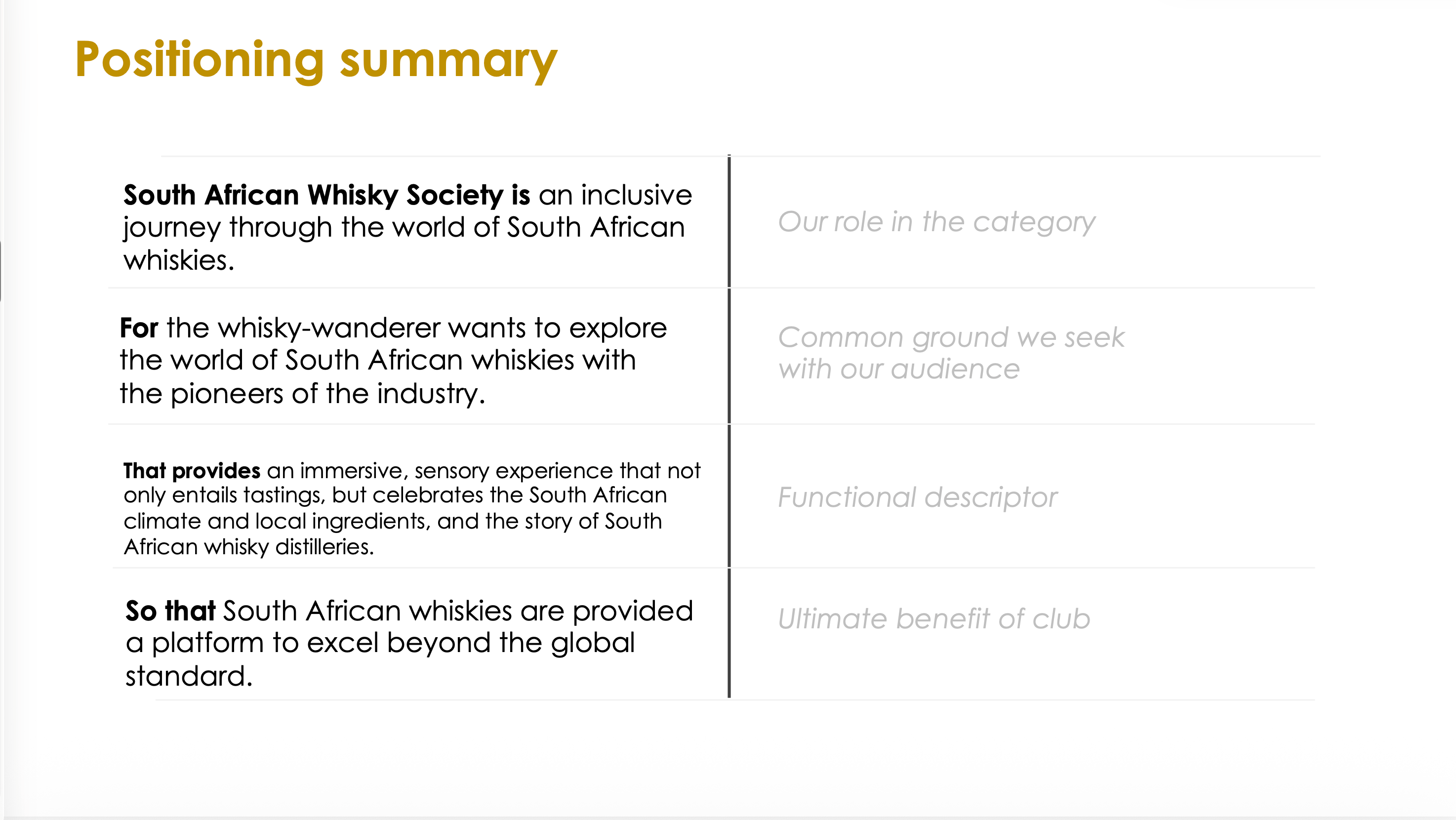
A society inviting whisky-wanderers to join the journey of the South African Whisky Revolution.
The positioning moved whisky from a world you had to qualify for, to a movement you could join.
The customer experience strategy
The appeal was also the biggest barrier.
The traditional, elitist "club" mentality creates immense cognitive load and intimidation.
This was the insight everything else hung on.
"I would really like to be part of a whisky club, but there are so many different whiskies and I feel I don't know enough to be a part of one."
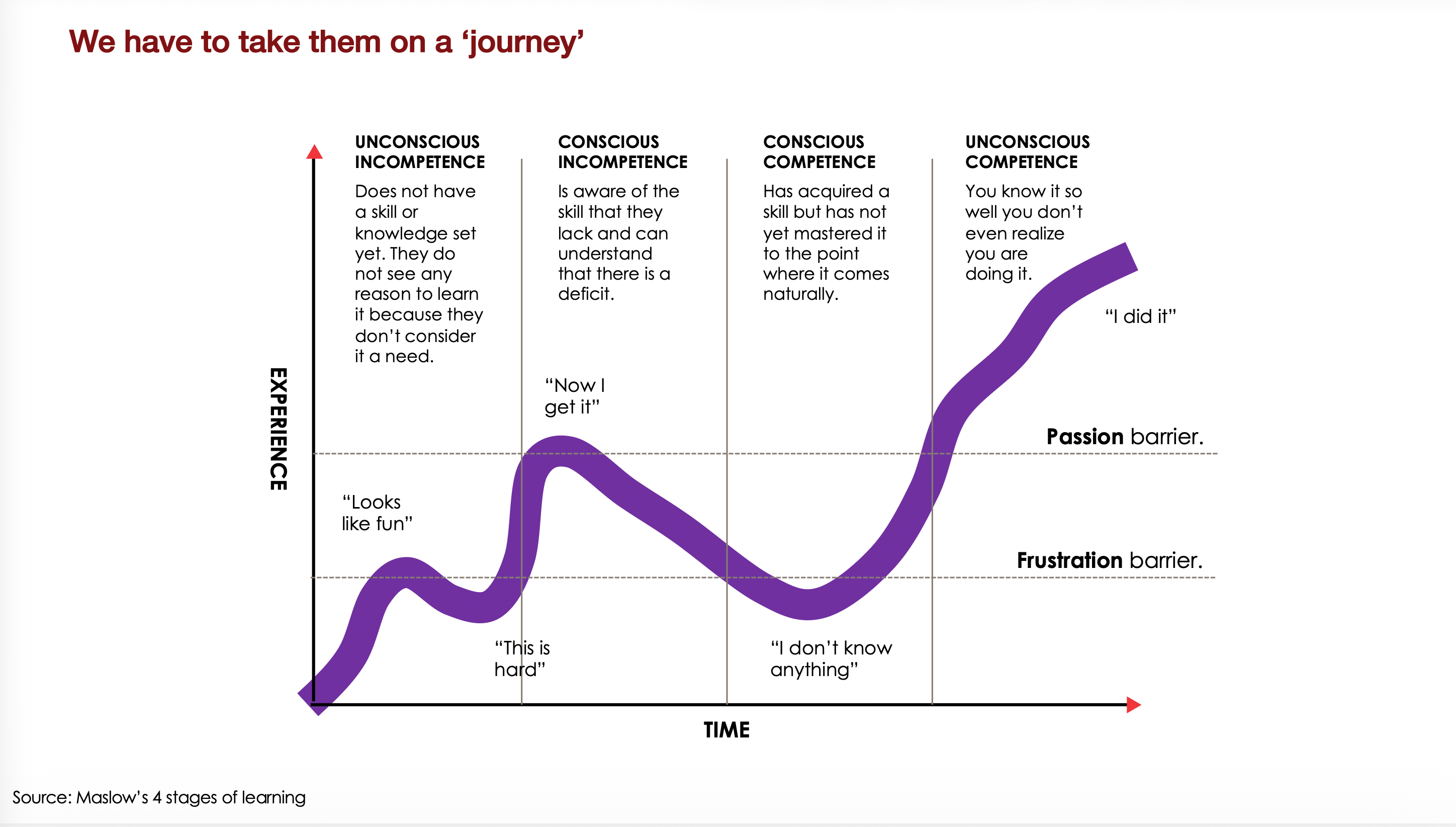
Mapped against Maslow's four stages of learning, this showed up as two clear drop-off points: 1. A frustration barrier before people even started, 2. A passion barrier once they tried. Most never got far enough to find out they'd enjoy the journey.
The strategy needed to build confidence through education — but pitched at the level each person was actually at. Using segmentation and sign-up data to understand each member's experience, knowledge, and preferences, the club could meet curious beginners, casual drinkers, cocktail explorers, and committed enthusiasts exactly where they stood. The experience also needed diversity in execution: who hosted it, who attended, how the whisky was consumed, and how people were invited in.
At launchConnoisseurs and Trend Adopters were the primary audiences because both already showed above-average interest in whisky. They were lower-friction to convert, and each played a distinct role in building a community from zero.
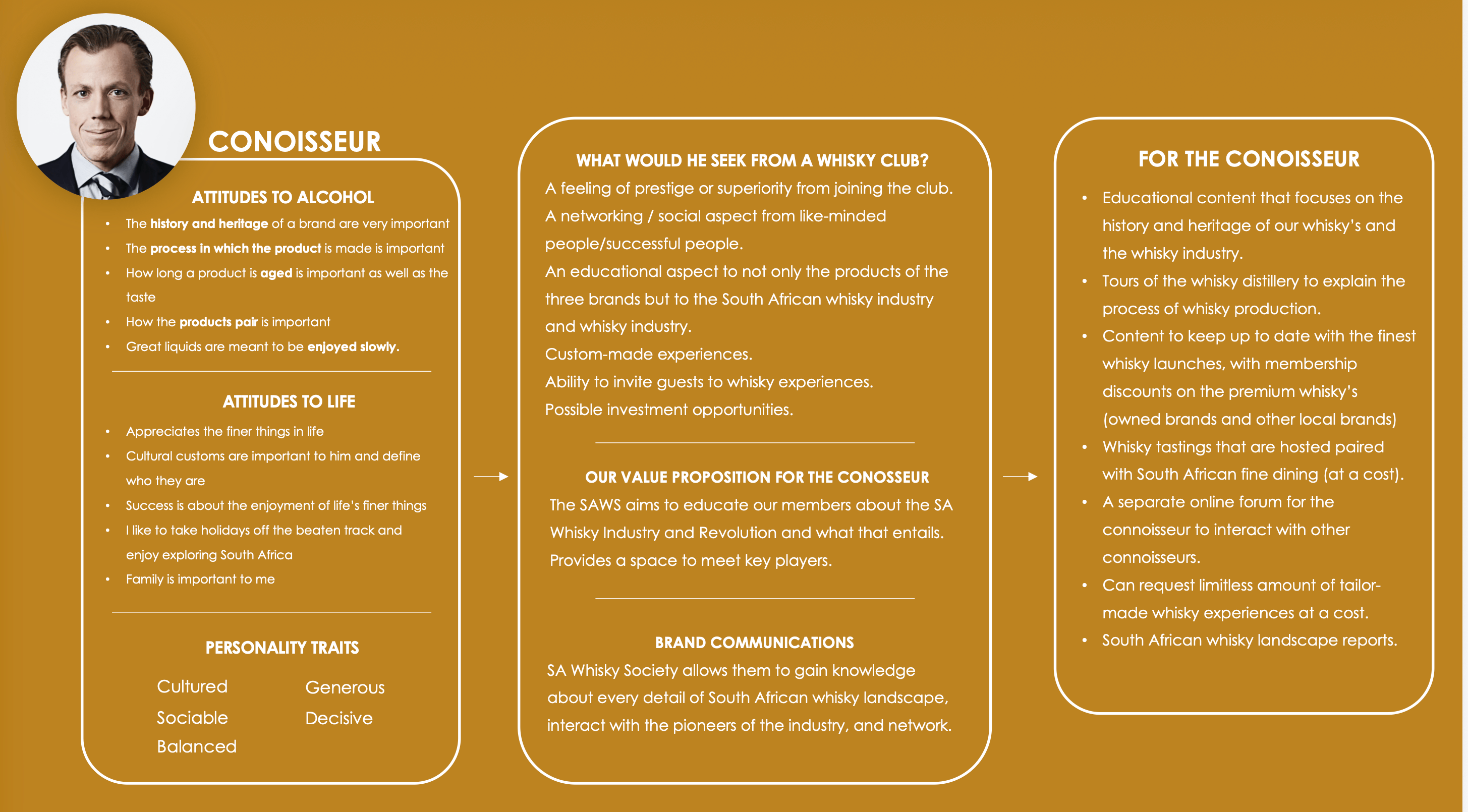
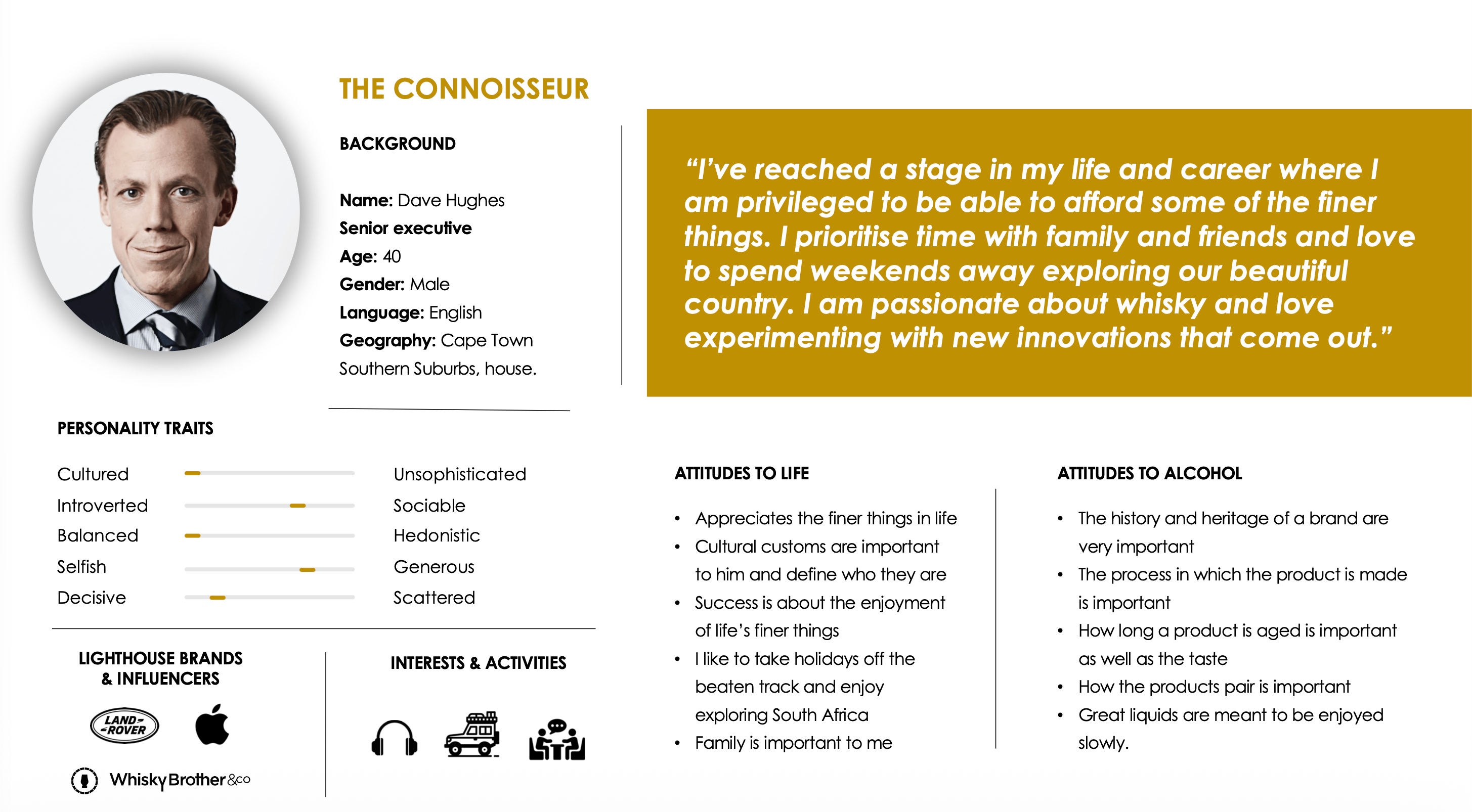
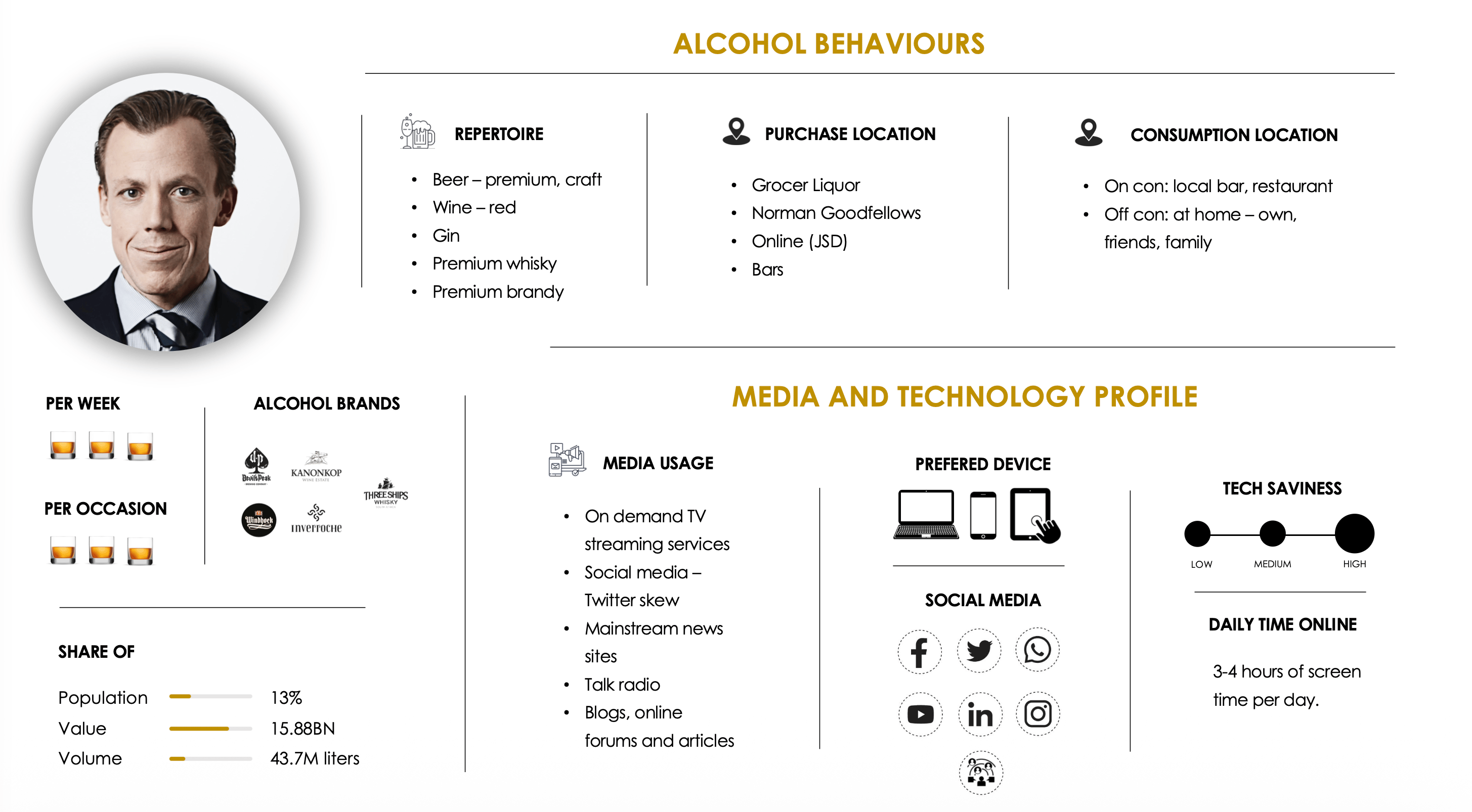
The Connoisseur Primary | The credibility anchor. Serious whisky drinkers joining first would signal to everyone who followed that the Society was worth belonging to. But there was also a genuinely fresh offer for them: a platform focused exclusively on South African whisky was new territory.
For a segment driven by depth of knowledge, category craft and an increasingly strong “support local” instinct, that was the hook: a chance to become expert in something the broader whisky world had not caught up with yet.
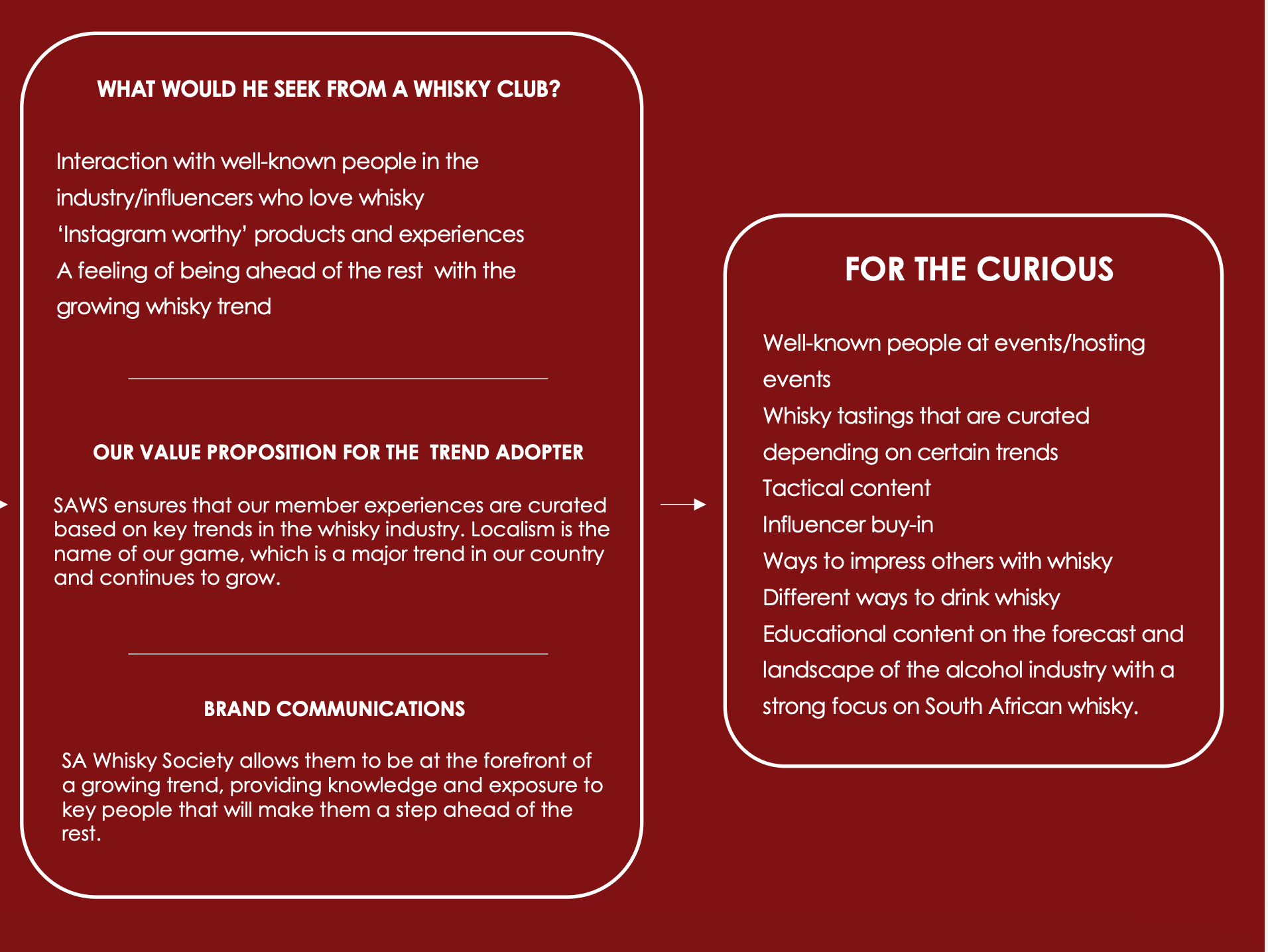
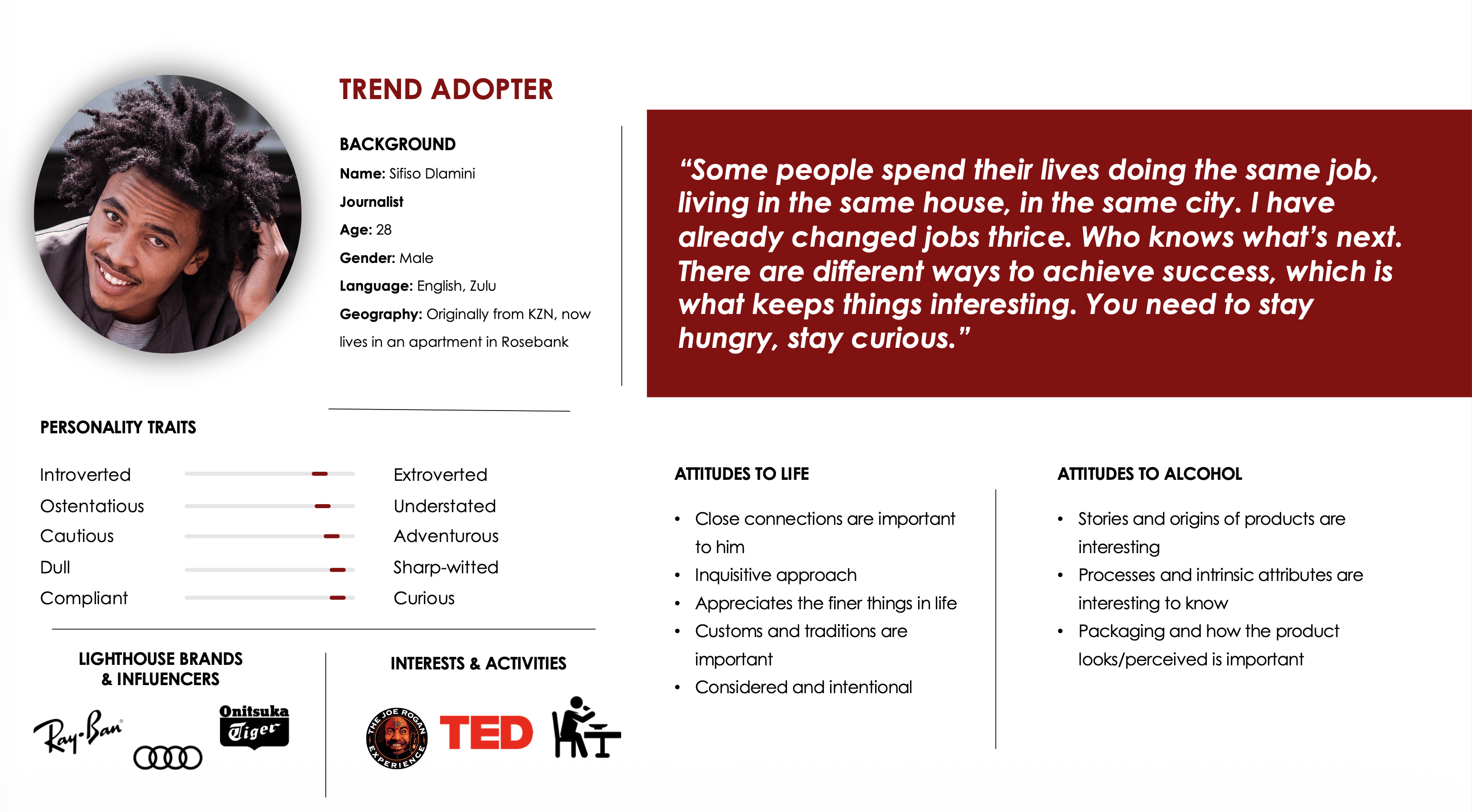
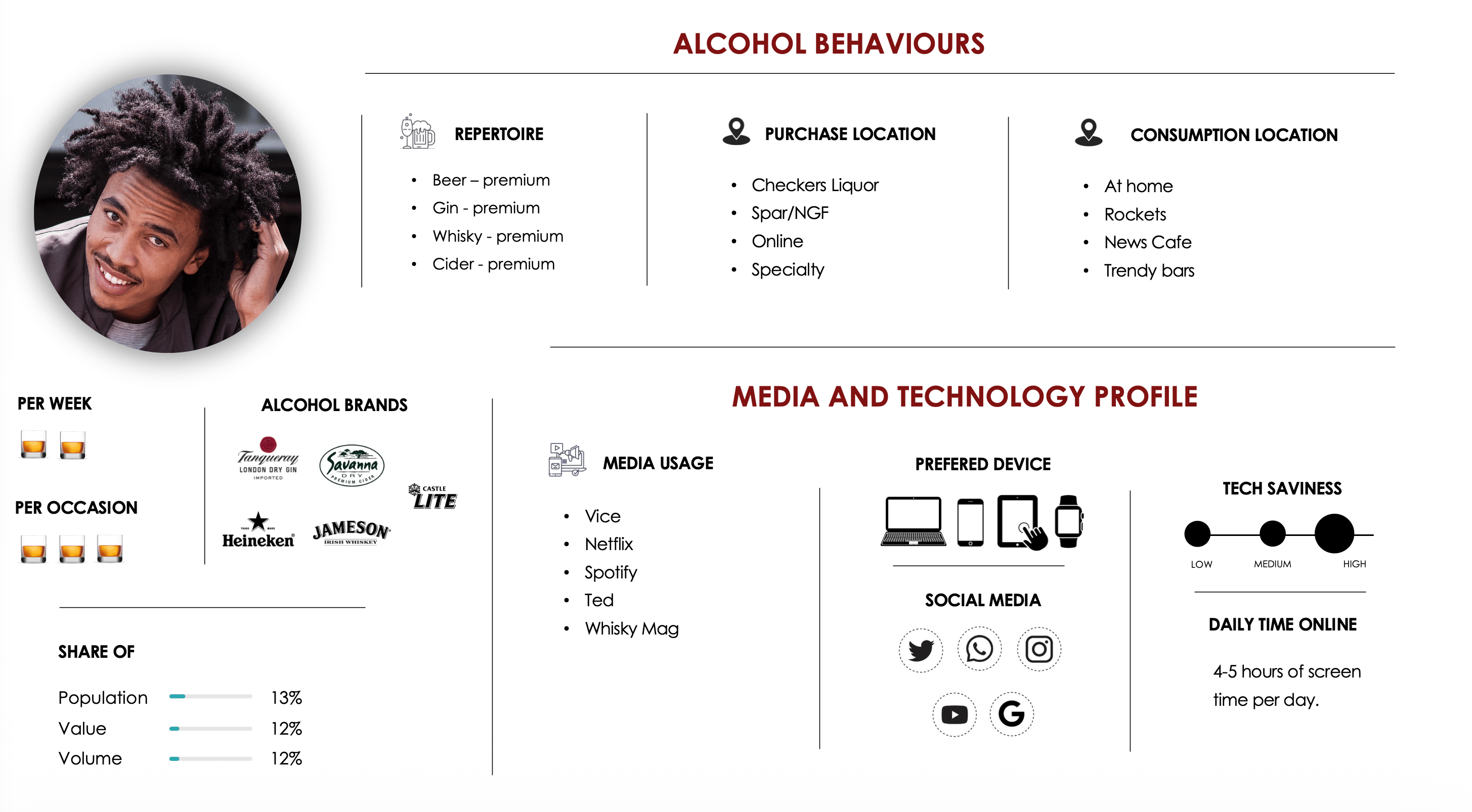
The Trend Adopter Growth engine | The relevance proof.Younger, culturally connected and more likely to move between category waves — rum, gin, cocktails, whatever is currently gathering heat — they represented the larger untapped opportunity.
The pitch to them could not be “learn whisky tradition”. It had to be: South African whisky is the next thing, and you can be ahead of it.
Content for this segment therefore had to lead with cultural currency, trend relevance, alternative serves and new experiences — not deep craft language from the first touchpoint.
Together, these two audiences gave the Society its launch base.
Post Launch
Connoisseurs and Trend Adopters would move into a nurture and maintenance phase: retained, engaged and used to sharpen the experience through feedback, participation and CRM learning.
Status Seekers and Conscious Connectors would then become more efficient to reach, because the Society would no longer be asking them to imagine the community. They would be able to see it.
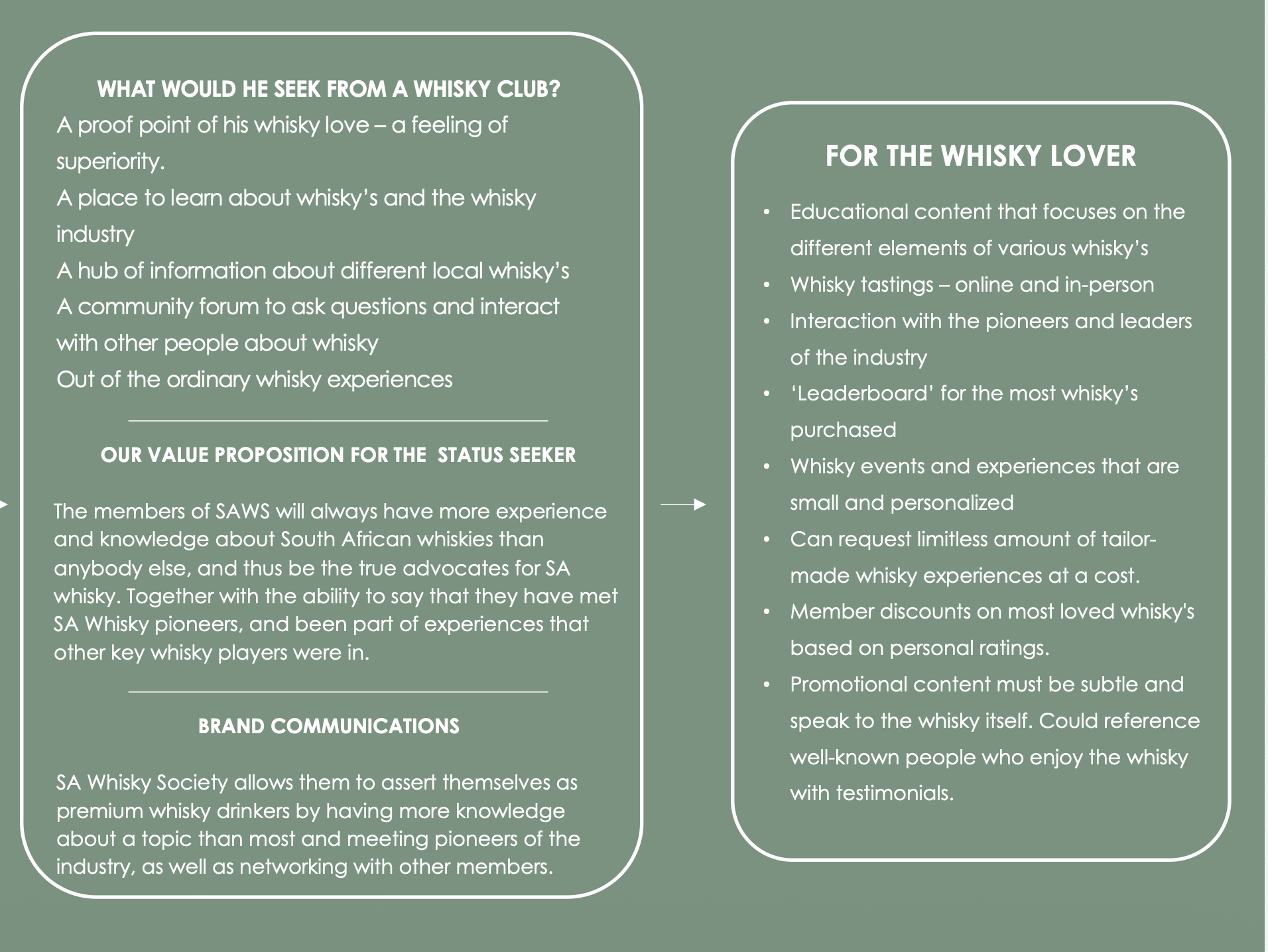
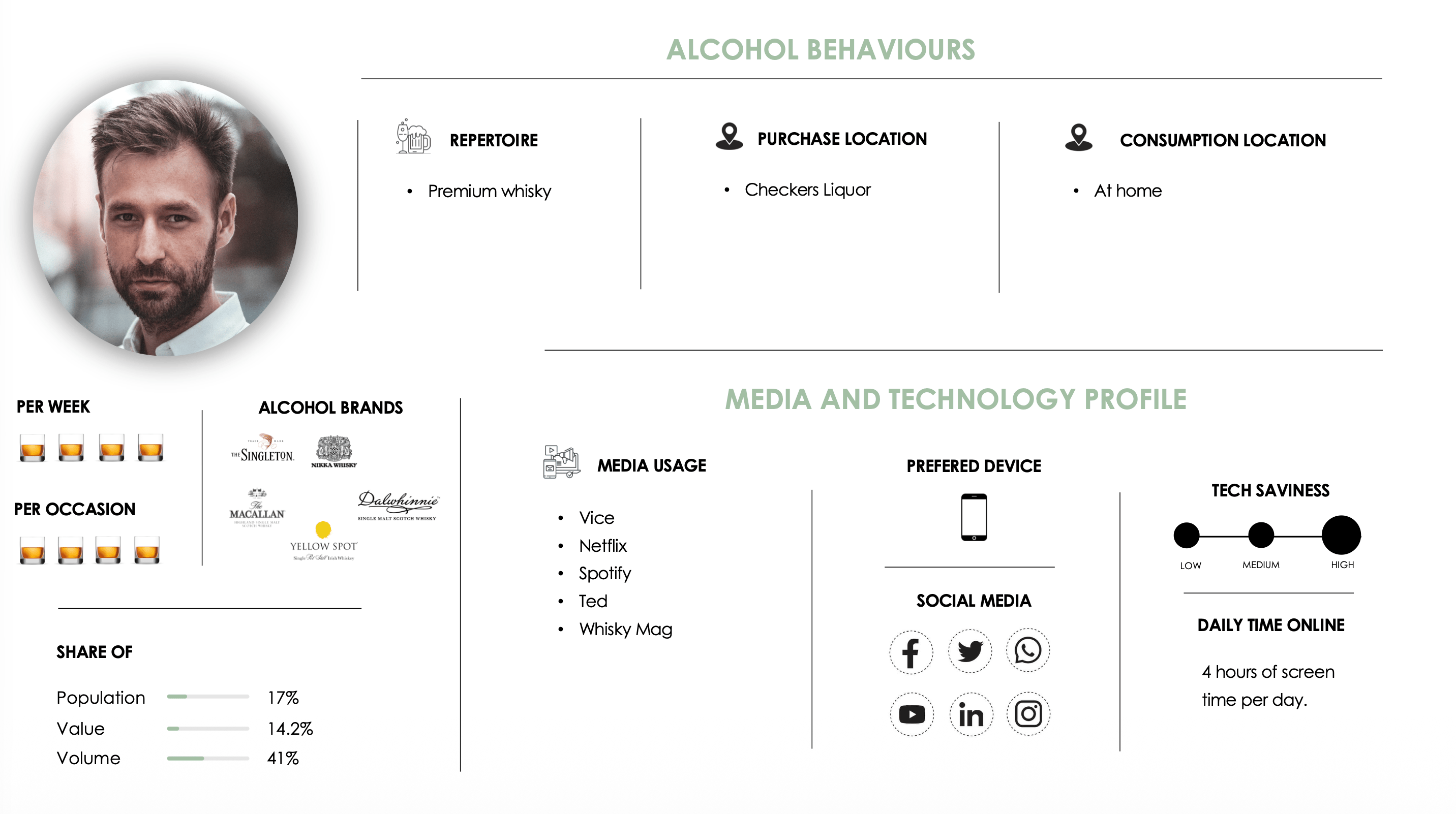
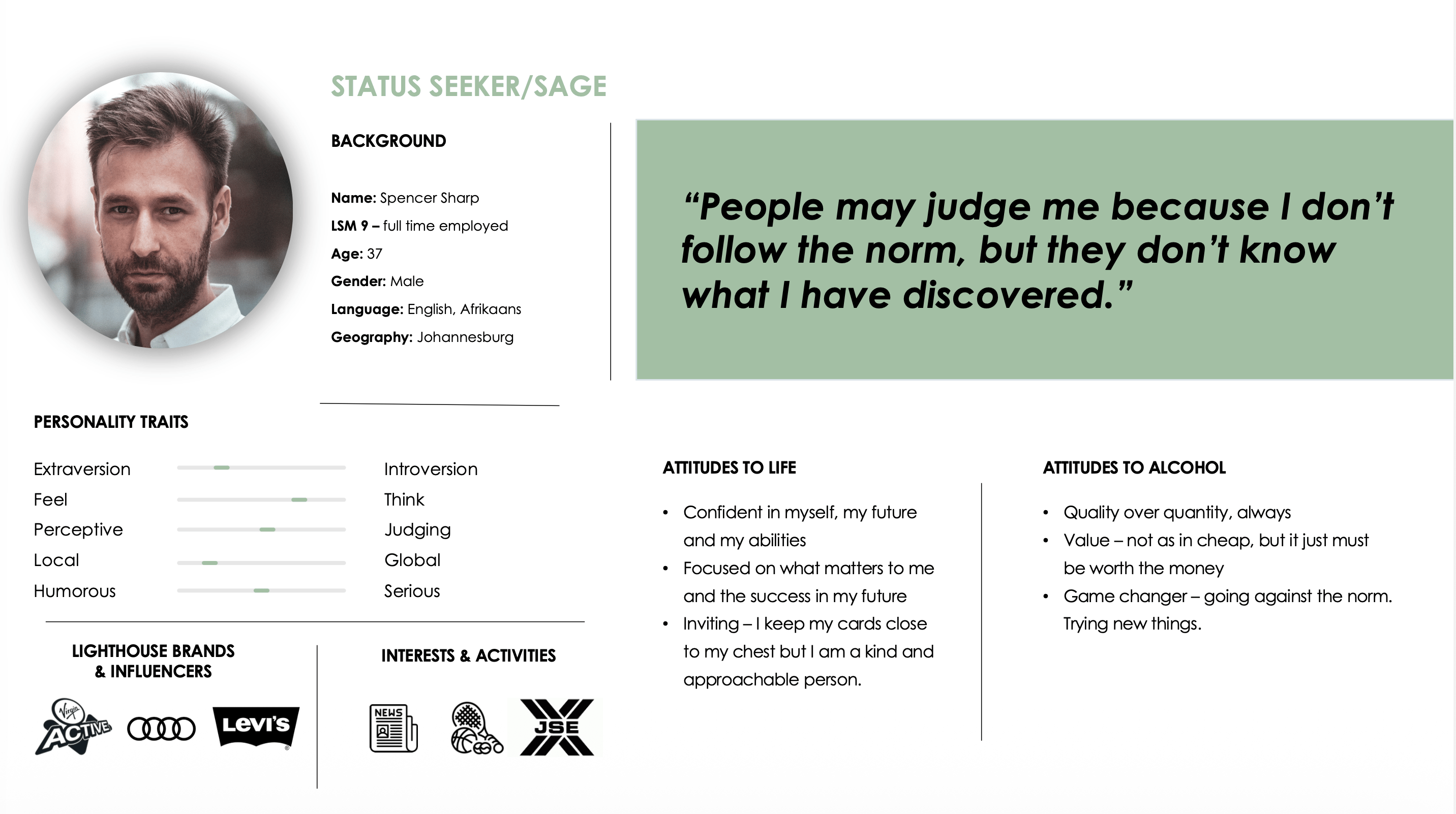
The Status Seeker Driver: StatusThis audience was drawn to quality, value, insider access and experiences that felt worth talking about. They were not looking for whisky education in the abstract; they were looking for proof that their taste was premium, informed and ahead of the norm.
So the Society’s role for them was to create visible social proof: credible members, access to pioneers, bespoke experiences, subtle status cues and the ability to say they had been part of something others had not.
They were not the first audience to build around, because status needs something to attach itself to. But once the Society had credibility and cultural momentum, they became the natural amplifier.
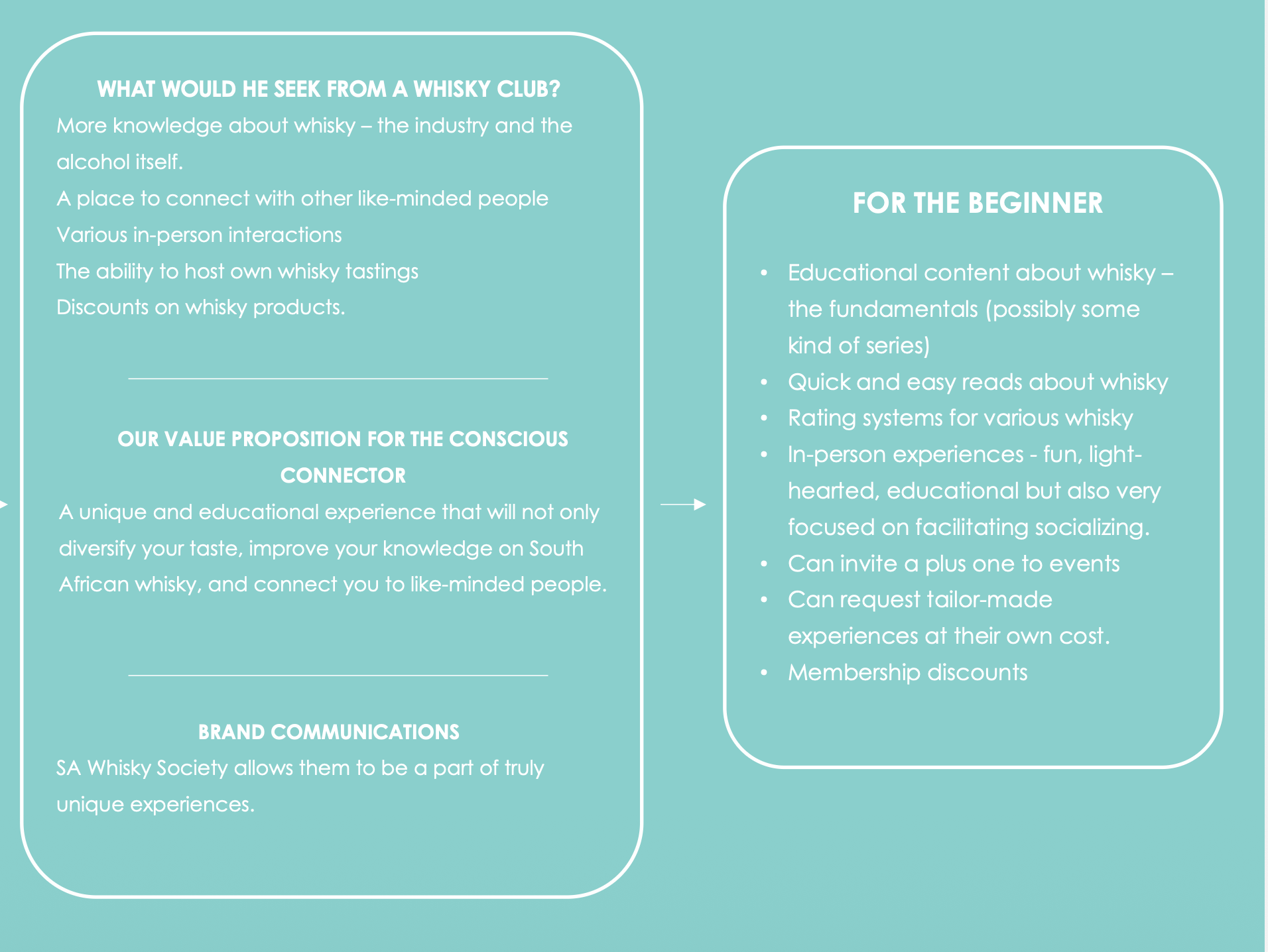
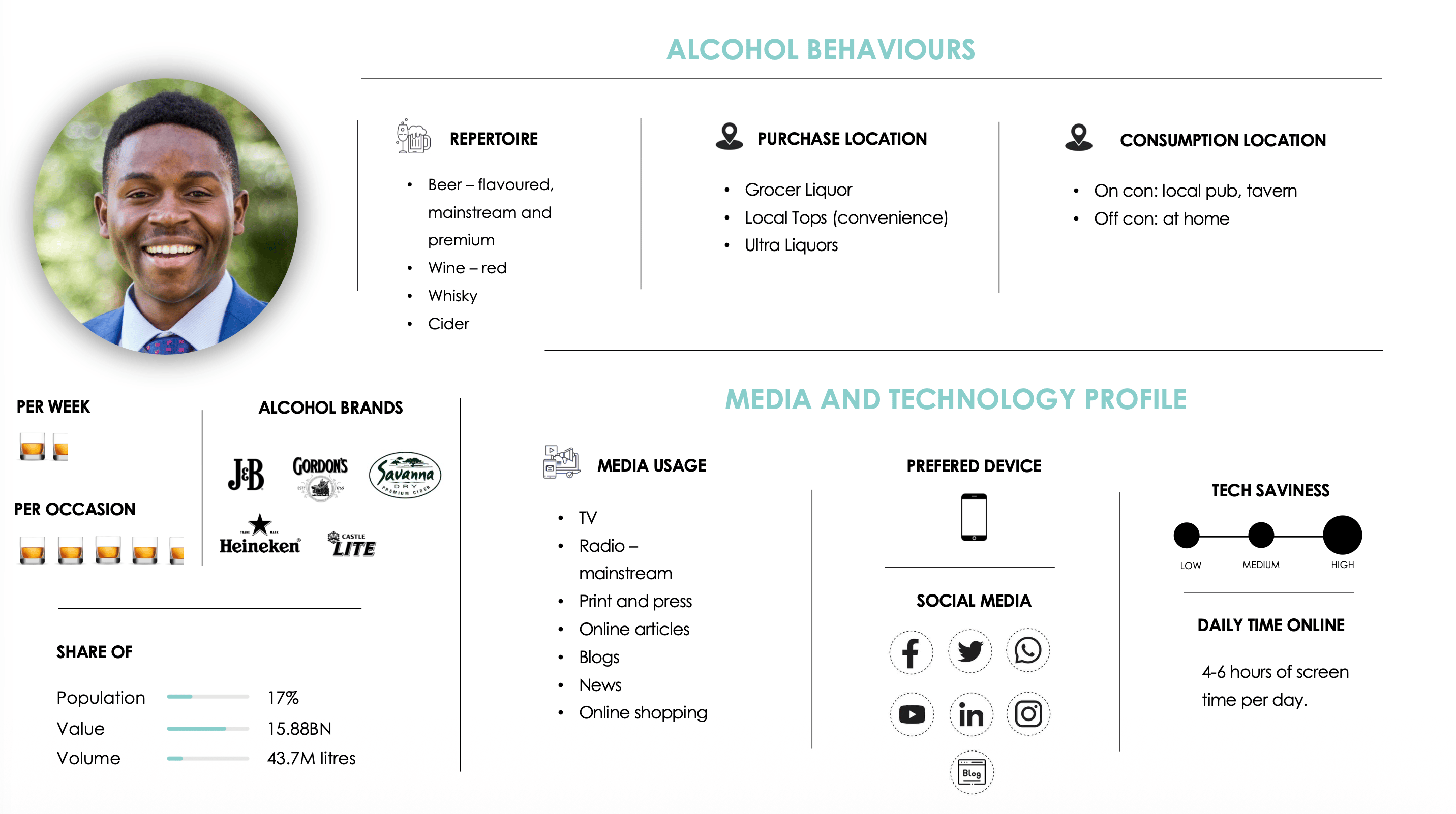
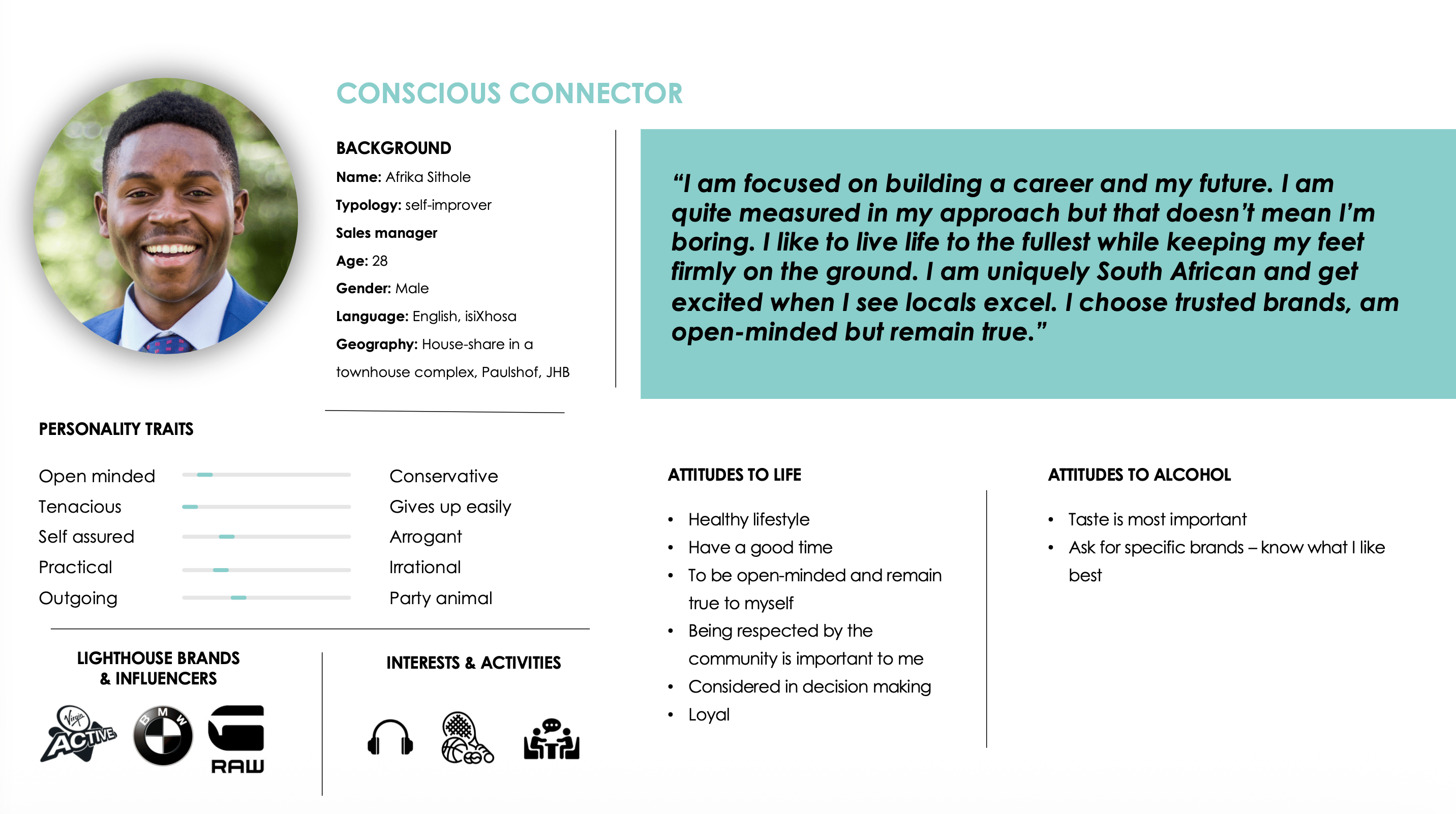
Conscious Connector Driver: BelongingThey needed a different route in.
This audience was open-minded, social and community-led, but less likely to enter through expertise or status alone. Their barrier was confidence: whisky had to feel less like a test of knowledge and more like a shared experience they could enjoy, learn from and bring others into.
For them, the Society needed to feel welcoming, useful and socially rewarding — quick educational content, ratings and reviews, light-hearted in-person experiences, plus-one access, and opportunities to connect with like-minded people.
They became more valuable once the Society had enough visible community behaviour to make participation feel safe. Not an intimidating room full of experts. A place to learn, taste, ask, share and belong.
Credibility → Relevance → Status → Belonging
The segmentation was a sequence for building belief.
Segmentation, propositions & messaging
The segmentation question was commercially specific: how do we appeal to a diverse range of whisky drinkers by providing only South African whiskies?
The Society had to earn the trust of serious whisky drinkers, but still leave the door open for the people who were curious, socially motivated and interested — just not yet confident enough to walk into the room first.
Four segments emerged from market analysis: Connoisseur, Trend Adopter, Status Seeker and Conscious Connector. They were mapped on two axes: whisky experience and appetite for education.
At launchConnoisseurs and Trend Adopters were the primary audiences because both already showed above-average interest in whisky. They were lower-friction to convert, and each played a distinct role in building a community from zero.
For Dash & Dram, sign-up was the start of the growth system, not the final conversion point.
I designed the go-to-market model as a circular loop: every member who joined, learned, attended, shared or advocated could feed the next wave of acquisition.
That meant Dash & Dram needed reasons to participate after sign-up, not just reasons to join. Membership pathways, event logic, CRM flows, social proof and community visibility all had a role in keeping the loop moving.
A membership-powered growth loop
Go-to-market strategy
The launch model was designed around momentum.
Go-to-market & Membership System: A membership-powered growth loop
1. Convert
From motivation to membership
The system translated audience motivation into sign-up confidence.
The segmentation work had already defined the four motivations. The go-to-market challenge was turning those motivations into a membership journey that felt personally relevant without splitting the Society into separate clubs.
The answer was one Society with multiple doors in.
The acquisition journey was mapped around what the Society could control and what only the prospective member could decide. Research and verification were ours to influence: SEO, website clarity, social proof, featured members, testimonials, membership details and a clear differentiating factor. Decision and commitment belonged to the individual.
That distinction shaped the journey.
The sign-up flow was crucial for personalisation.
At research, the Society had to be easy to find and instantly different.At verification, credibility had to be visible through testimonials, leadership features and recognisable members.At decision, membership options had to map clearly to different audience needs.At sign-up, the questions had to feed the CRM logic that would shape future communication.
The lowest-confidence moment in the journey was around member reviews and social proof. The fix was structural: make credible members, leadership and testimonials easy to find, so prospective members could see who the Society was for before deciding whether it was for them.
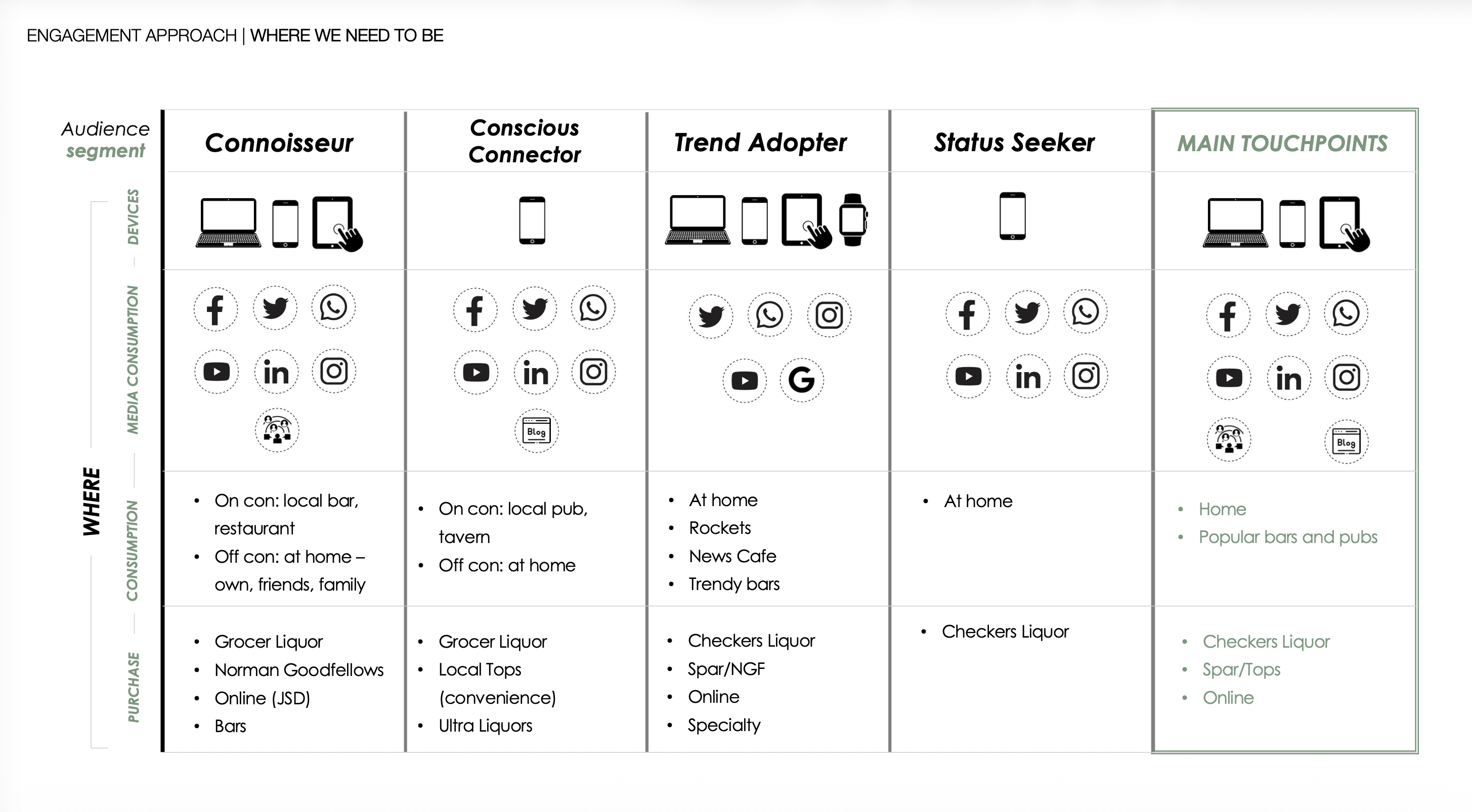
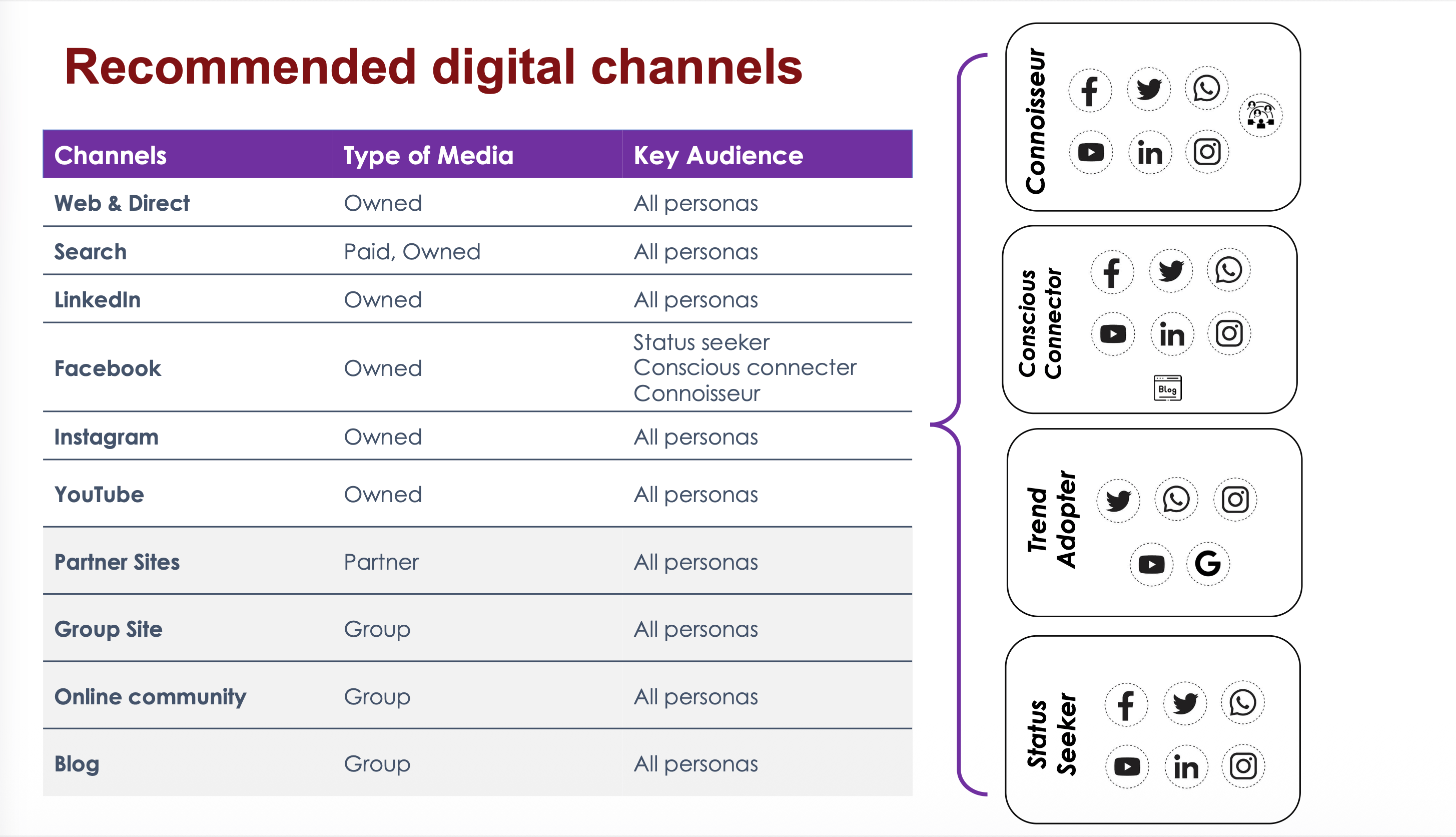
The audience strategy shaped who we reached, where we reached them, and what each message needed to do.
2. Activate
Segmentation made operational
Platform selection, device targeting and audience signals were drawn directly from the persona profiles. The segmentation work and the channel strategy were the same system viewed at different levels.
Connoisseurs needed deeper content, community and credibility signals.Trend Adopters needed culturally current, mobile-friendly content and trend-led hooks.Status Seekers needed visible proof of exclusivity, quality and social value.Conscious Connectors needed community, easy education and shared experience cues.
This shaped where the Society showed up and what each channel had to do.
The paid acquisition plan was designed around a warm-start data strategy. Each partner brand contributed its existing first-party audience data to an approved merger plan, creating the foundation for one unified Society audience asset. Lookalike audiences could then be built outward from those warmer audience pools using the fused persona profiles.
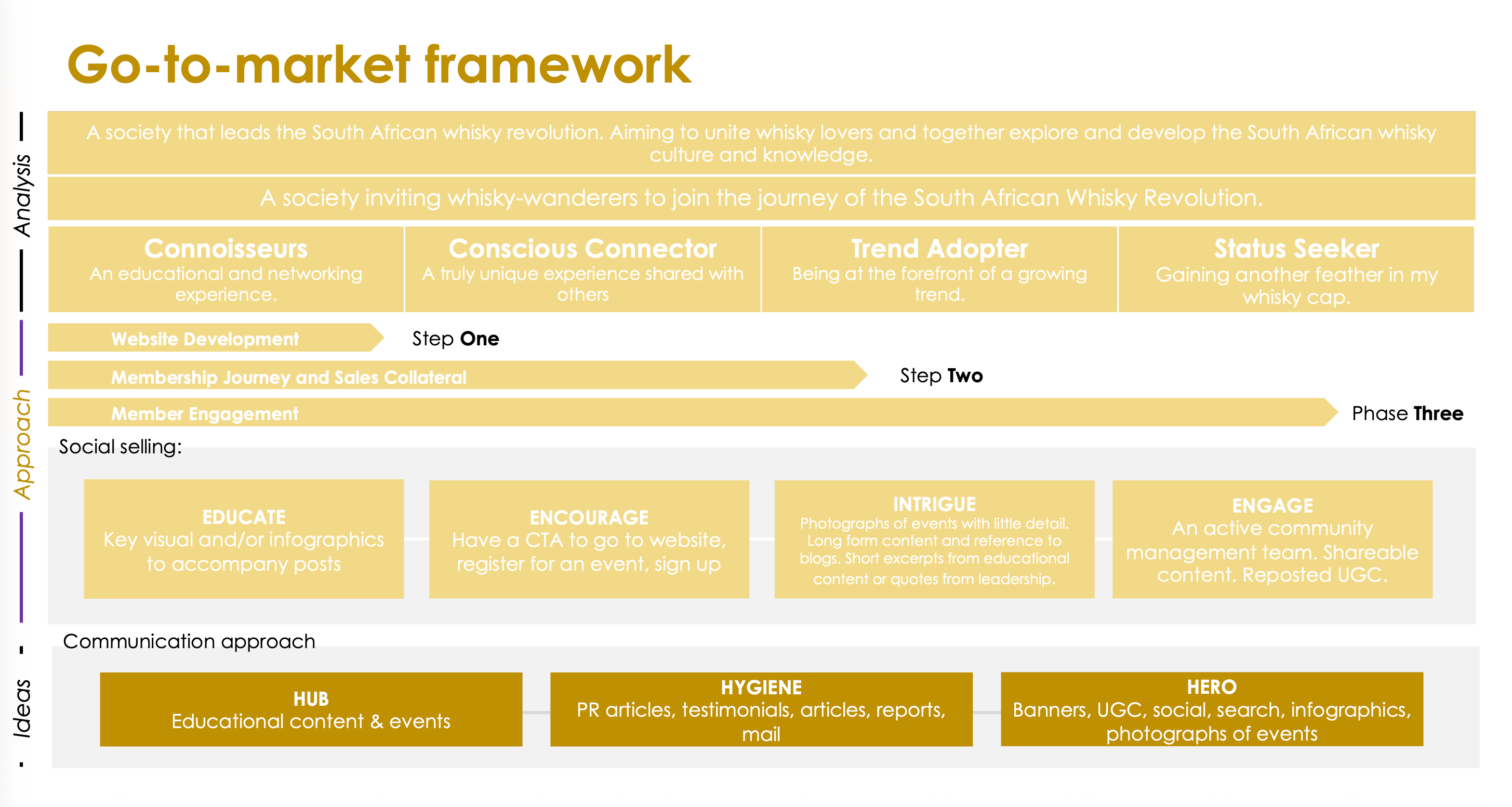
The rollout gave the Society a way to grow ambition without outrunning the system built to hold it.
3 Scale
A phased launch to manage risk
Each phase had to earn the next.
The rollout was sequenced deliberately because this was effectively a category-creation launch with no direct precedent in the South African market.
Phase One: website, CRM architecture and approved merged-audience plan.Phase Two: paid and organic activation.Phase Three: events, partnerships and CRM running at capacity.
The logic was simple: build the infrastructure before scaling the noise. Website, database, membership journey and CRM had to be ready before events, partnerships and full community activation could work properly.
4. Sustain
Community and content after sign-up
The post-sign-up experience gave members reasons to return.
Once someone joined, the job shifted from conversion to participation.
The welcome experience was designed to validate the decision through a membership card, small gift and digital certificate, depending on membership choice. These were not decorative touches. They were recommended as tangible signals of belonging — something new members could recognise, keep and share.
The online forum gave the community somewhere to return between events. Educational content gave members a way to build confidence at their own level. Events and tailor-made experiences gave the Society reasons to exist beyond the inbox.
CRM then connected the pieces: reviews, preferences and member needs could inform recommendations, event details and future content.
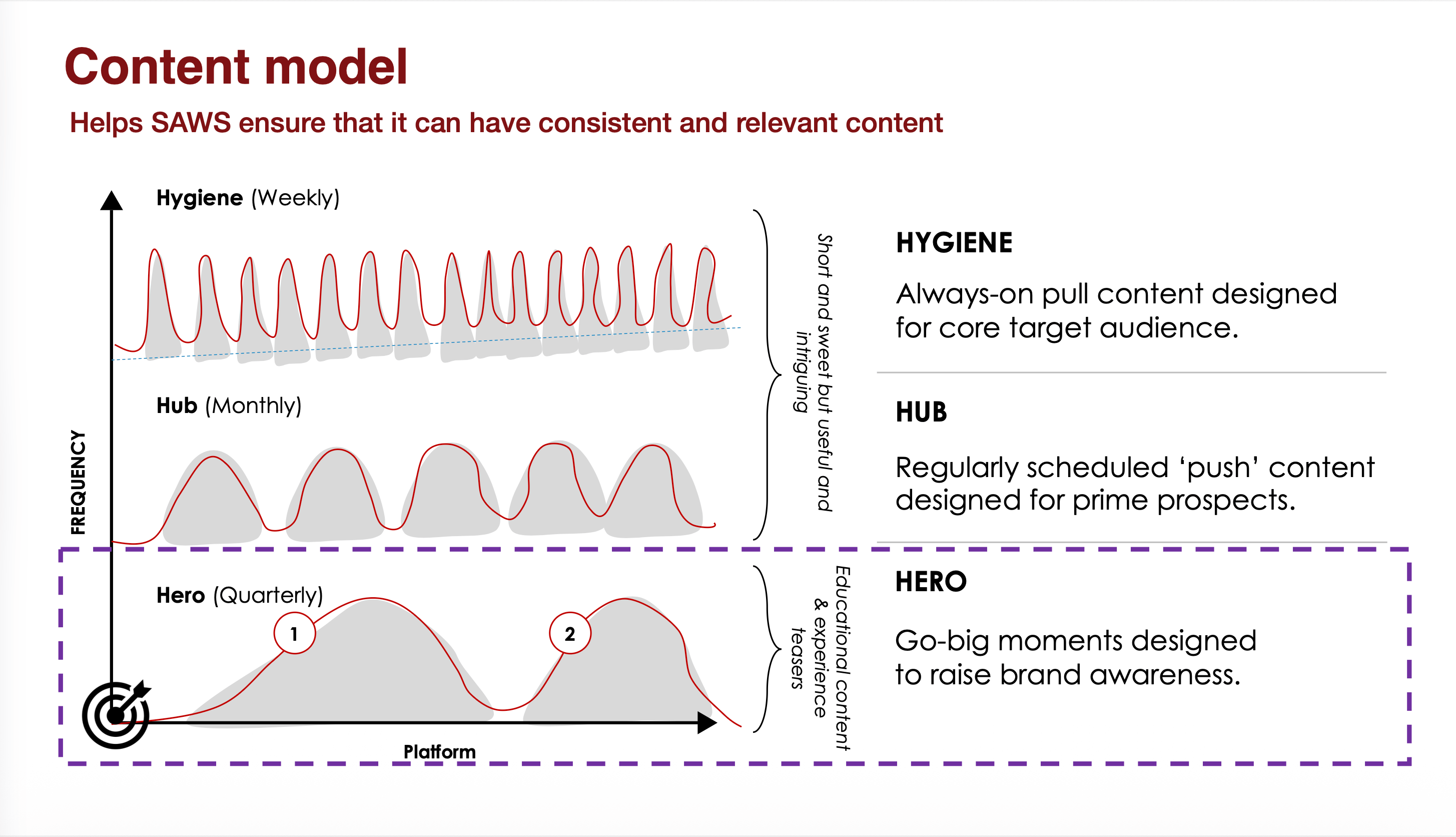
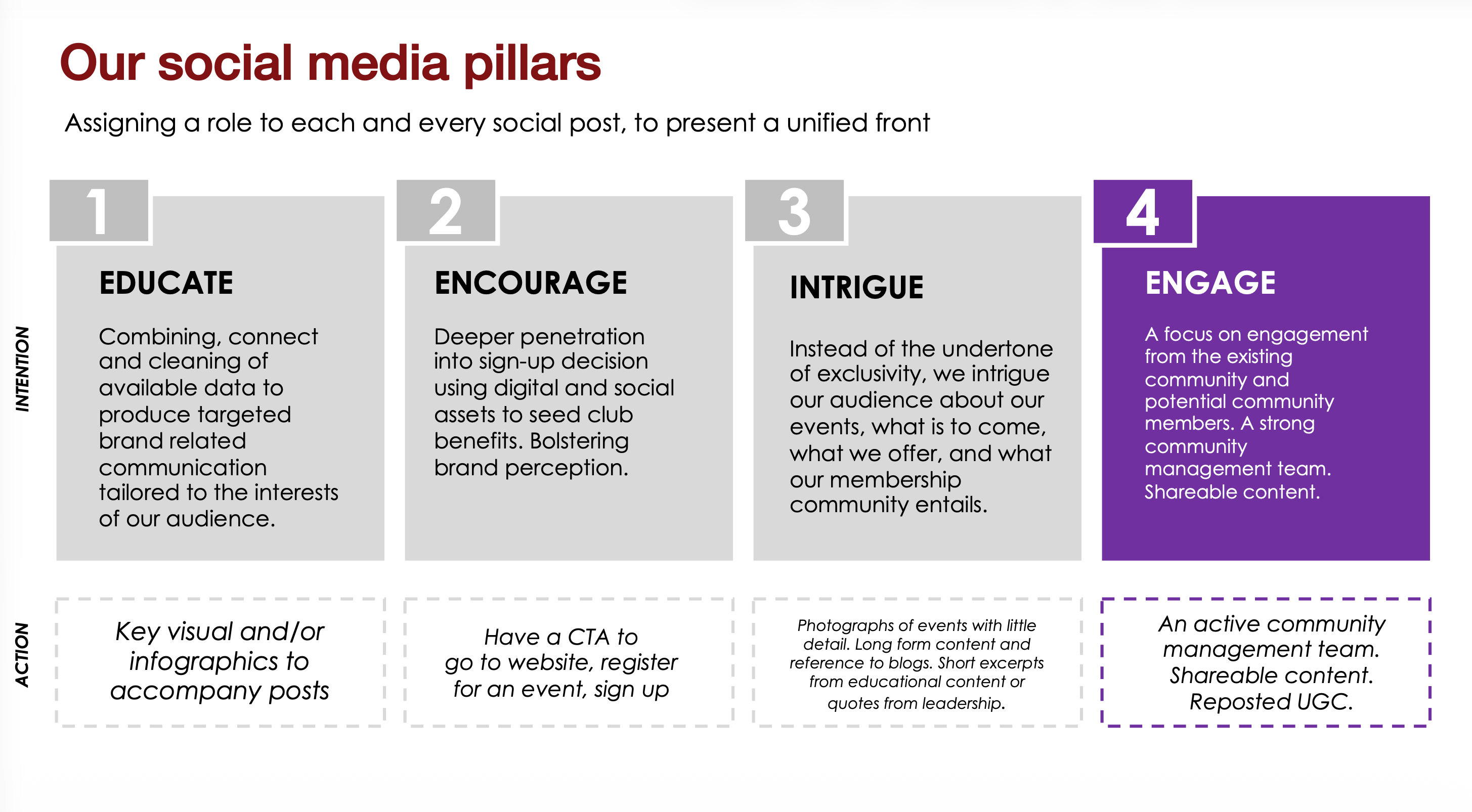
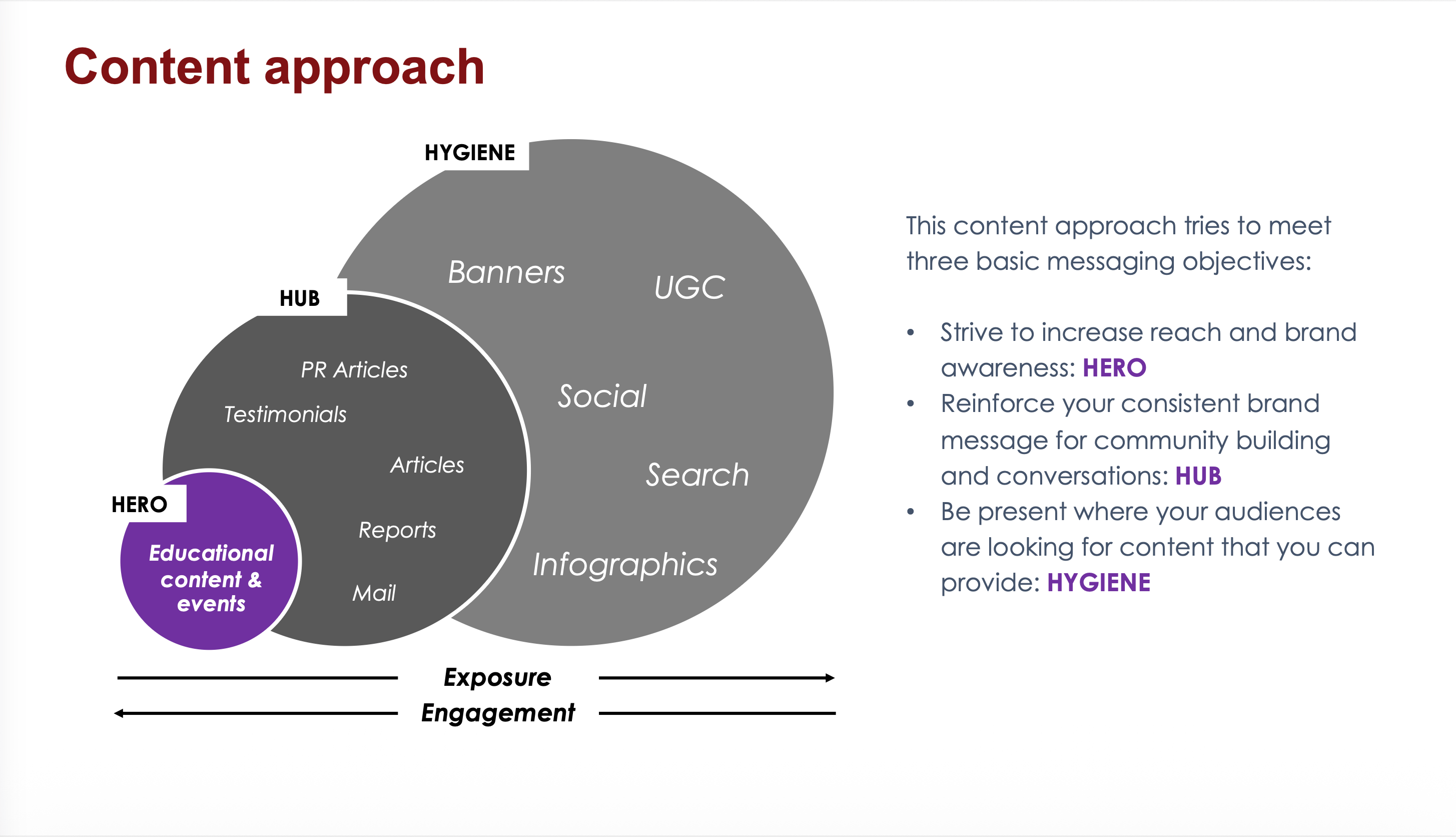
The Society had to make belonging feel useful after the first click, and move people from confidence to membership to advocacy.
The content architecture supported that loop through four jobs:
Educate — meet members at their actual level of whisky knowledge.Encourage — make the benefits of membership clear enough to support sign-up.Intrigue — make events and experiences feel desirable without making the Society feel closed.Engage — use community management and shareable content to turn members into advocates.
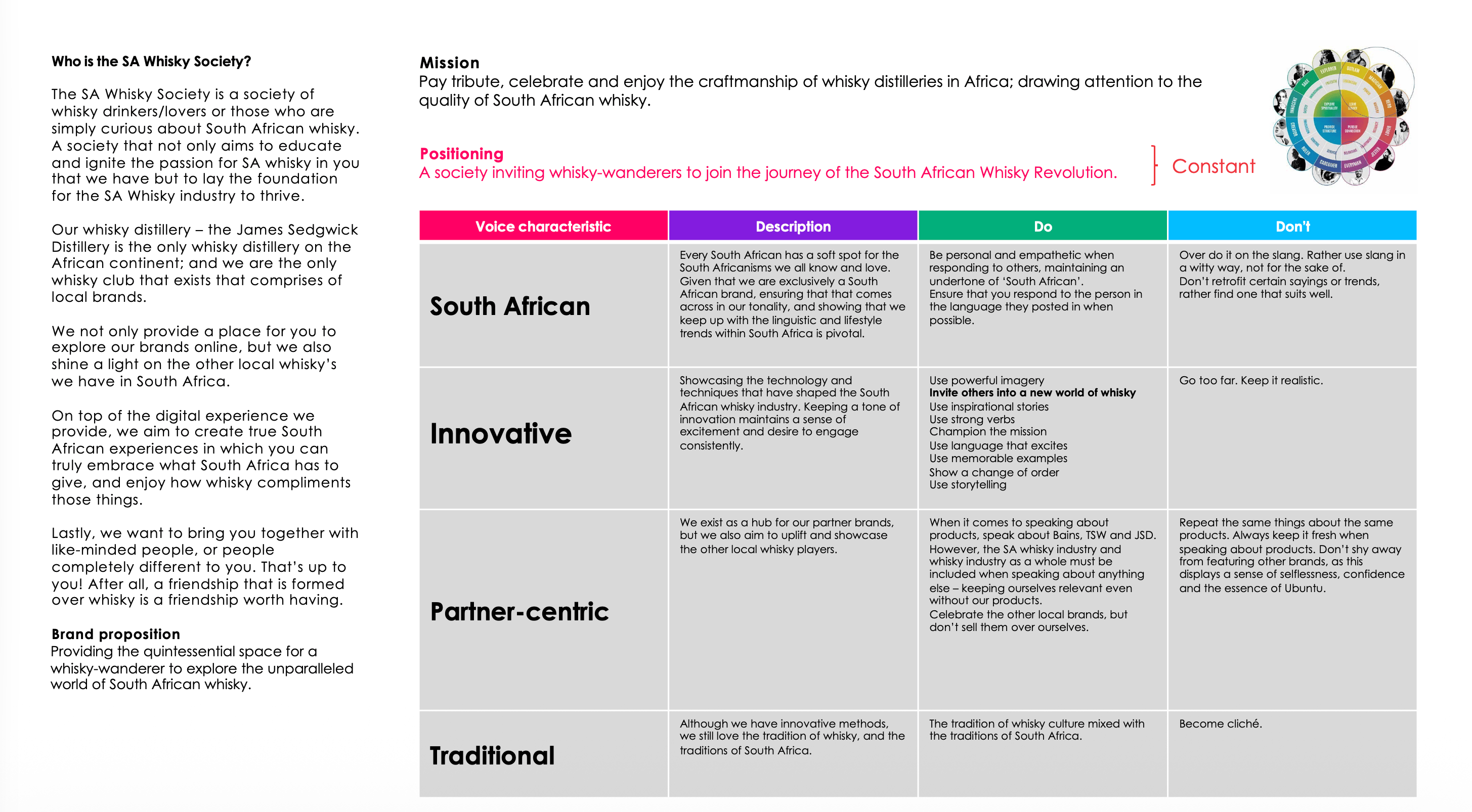
4. Govern Protecting three brands inside one Society
The cannibalisation risk was solved through behaviour.
The most commercially sensitive constraint was promoting Bain’s, Three Ships and James Sedgwick Distillery equally without letting one brand dominate the platform.
I defined the Society’s voice and tone guardrails around that exact problem.
When the Society spoke about products, Bain’s, Three Ships and JSD had to be represented with equal weight. When the Society spoke about anything broader — whisky culture, education, industry progress, local craft — it could include the wider South African whisky world.
Additionally, I suggested featuring other, smaller, local whisky players to make Dash & Dram more credible as a category platform. Internally, this was the Ubuntu logic (the essence of being South African): confidence, selflessness and collective pride.
The result was brand architecture with enough clarity for the business, credibility for enthusiasts, and openness for the curious.
4.8k+
unique visitorsin 48 hours
20%
conversion rate
832
sign-upsin 48 hours
©2026 All Rights Reserved.

kimhutton.
A doorway for the curious. A destination for enthusiasts. A relationship engine for Heineken Beverages.
Client: Distell, now Heineken BeveragesBrands: Bain’s · Three Ships · James Sedgwick DistilleryRole: Senior Digital Insights ManagerFocus: Brand strategy · Positioning · Customer experience · Membership strategy · Audience segmentation · CRM · Go-to-marketScope: South AfricaProof: 4,852 unique visitors in 48 hours · 832 sign-ups · 20% conversion rate
Career impact: Promotion to Senior Brand Strategist across Hoorah Group’s portfolio and Heineken Beverages.
Context
The Centre of Intelligence team I led — six direct reports and myself — had just delivered a Spirits Consumer Trends & Forecast report: threats, opportunities and market signals across the category.
Buried in it was a problem: whisky had the lowest popularity and the lowest related conversation of any spirit among younger audiences.
The reason was not taste. It was perception.
Whisky felt elitist. Exclusive. A dim-lit mahogany bar, leather wingbacks and polished shoes — that was the “vibe” people associated with the category, and it was the single most commonly cited negative sentiment around whisky in the data.
As the Insights Manager, I identified the whitespace: if whisky wanted to appeal to younger audiences, it needed to tackle that perception head-on, with education, confidence-building and nurturing. Done correctly, it could become a genuine long-term asset for the company.
“Like a whisky club, for example.”
Whisky Club Brief:
Develop a whisky club for Bain's, Three Ships and James Sedgwick Distillery that could:
I owned everything that followed — research, brand architecture, positioning, segmentation, UX, GTM — end to end.
The whisky paradox
Whisky drinking was never just about the liquid. It was about the experience around it — shaped by how people felt while participating, and how they believed they would be perceived for taking part. Whisky was a social signal.
Every whisky club in South Africa at the time leaned hard into the elitist cigar-lounge aesthetic. Surprisingly, audience research showed that people who already liked whisky often appreciated that lifestyle. The premium world, the ritual, the taste cues and the codes of sophistication were not irrelevant. They were part of the appeal.
The problem was that premium often felt closed.
The data pointed to where: audiences were already drinking whisky in non-traditional ways. Cocktails were popular both on- and off-trade. Yet every competitor still positioned whisky in a purist fashion, gatekeeping the very behaviour that could grow the category — an untapped market hiding in plain sight, and proof that lowering the barrier to entry from purists-only to curious cocktail drinkers wasn't sacrilege, if done right.
That meant the premium codes couldn't be discarded — they needed reinterpreting. Not stripped of sophistication, but re-rooted in something distinctly South African: the natural ingredients shaped by the African sun, the pioneering distilleries, the craft of a whisky industry still writing its own story. A naturally local sophistication, rather than the imported, imitative elitism that had defined the category until now.
The Challenge
Make exclusivity feel like an invitation rather than a restriction.The premium, members-only quality that made whisky desirable had to remain — but it had to be opened up, so that curiosity, not expertise, was the price of entry. Get that balance wrong in either direction and the brand either loses its appeal or re-erects the same barrier it set out to remove.
The Opportunity
Shift the signal — from elitist and intimidating to confident, curious and culturally desirable. Creating a membership experience that could open up the category while protecting what made whisky feel worth joining in the first place.
The Whitespace
Creating a new premium [South African] code - a way to make whisky feel confident, curious and culturally desirable — without making it feel less premium.
Imported Elitism
Dark rooms · expertise anxiety · purist rules · exclusion
Naturally local sophistication
South African sun · local craft · pioneering distilleries · confidence through pride

Every thread of research — competitor, category, and macro-environment — kept returning to the same term: South African.
All three partner brands already carried local craft and heritage independently, and “support local” was a rising cultural tide across South Africa.
That gave the strategy credible common ground.
It also gave the Society a way to solve the whisky paradox without stripping the category of its premium appeal.
South African whisky could create a different kind of sophistication: one rooted in local craft, natural ingredients shaped by the African sun, pioneering distilleries, and an industry still writing its own story.
Being seen supporting a South African whisky club immediately lowered the cognitive load of joining.
Participation no longer felt like stepping into an intimidating circle of experts. It felt like backing something proudly local, alongside everyone else doing the same.
The vision: A society that leads the South African whisky revolution. Aiming to unite whisky lovers and together explore, and develop, the South African Whisky Culture.
From insight to brand
What I needed to solve:
How do we build one Society that three distinct whisky brands could credibly belong to, without flattening their equity, favouring one product, or creating internal competition?
Method: Synthesis. I needed to find what elements of each brand crossed over but still maintained their own identity. I worked from each brand’s existing strategy, product role and ambition, but prioritised where the brands were trying to go over what their documents had historically said.
On a product level, Bain’s and Three Ships both had strong product portfolios, loyal audiences and some natural overlap between products, but then James Sedgwick Distillery was just a distillery. Without a product hat in the ring, James Sedgwick was the ‘neutral party’ from a competitor perspective, but it did provide a level of authority on craft, the process and distilleries. A vital reason to believe for this audience. So, JSD would be the brand home of this Whiskey Club. They would need to do the heavy lifting for the in-person experiences and collaborations with other whiskey distillers / voices of authority, for credibility. as well as provide the experiences and craft to the club.
Bain’s was widely known for its premium pedigree, and Three Ships were shooting for the same audience. Their brand approaches were pretty different though, which gave me a bit of room to work. I found that Three Ships was appreciated by their audiences for their ‘South Africanacity’, but their audience was whiskey-mixers and people new to whiskey, whereas the conoisseurs were behind Bain’s for their pedigree.
The common ground they all had, that was not competitive territory, was being proudly South African.
The solve:How does each brand contribute to South African Whisky Culture?


Category Differentiators
Makers & Process
Distillery authority
Craft authority
Reason to Believe
Brand Role
within Dash & Dram
South African quality
Grounded ingenuity
Quality benchmark
Premium pedigree
Mastery, remastered
Pedigree standard


A shared platform for South African whisky culture
Together, they created a brand system that could hold product, education, access, experience and national pride without making any one bottle the hero.
Brand DNA
Positioning
Macro-environment Insights
Category Insights
Brand Merger Opportunities
Consumer Insights
Brand Analysis
CREDIBILITY
TO CONSIDER
OPPORTUNITIES
DISTINCTION
RELEVANCE
RELEVANCE
The brand architecture clarified what the Society could credibly hold. The next question was what it should make people feel part of.
I mapped three positioning territories on a functional-to-emotional spectrum: Exploration, Revolution and Celebration.
Exploration was the most accessible territory. It gave curious drinkers permission to learn, taste and discover without needing to perform expertise. But on its own, it felt too functional — more tasting guide than cultural movement.
Celebration was the most emotionally obvious. It leaned into South African pride, local craft and national identity. But it risked narrowing the Society to people already motivated by localism, rather than inviting people who were simply curious about what whisky could become.
Revolution gave the Society the strongest middle ground. It held the ambition of the category shift without making the brand feel aggressive or exclusionary. It positioned South African whisky as something gathering momentum: a category with its own makers, codes, confidence and cultural energy.
That territory also gave the audience a more inviting role.
They did not need to arrive as experts. They could arrive as whisky-wanderers: curious, open, socially engaged and willing to discover the category as it evolved.
A society inviting whisky-wanderers to join the journey of the South African Whisky Revolution.
The positioning moved whisky from a world you had to qualify for, to a movement you could join.
The customer experience strategy
The appeal was also the biggest barrier.
The traditional, elitist "club" mentality creates immense cognitive load and intimidation.
This was the insight everything else hung on.
"I would really like to be part of a whisky club, but there are so many different whiskies and I feel I don't know enough to be a part of one."
Mapped against Maslow's four stages of learning, this showed up as two clear drop-off points: 1. A frustration barrier before people even started, 2. A passion barrier once they tried. Most never got far enough to find out they'd enjoy the journey.
The strategy needed to build confidence through education — but pitched at the level each person was actually at. Using segmentation and sign-up data to understand each member's experience, knowledge, and preferences, the club could meet curious beginners, casual drinkers, cocktail explorers, and committed enthusiasts exactly where they stood. The experience also needed diversity in execution: who hosted it, who attended, how the whisky was consumed, and how people were invited in.
Segmentation, propositions & messaging
The segmentation question was commercially specific: how do we appeal to a diverse range of whisky drinkers by providing only South African whiskies?
The Society had to earn the trust of serious whisky drinkers, but still leave the door open for the people who were curious, socially motivated and interested — just not yet confident enough to walk into the room first.
Four segments emerged from market analysis: Connoisseur, Trend Adopter, Status Seeker and Conscious Connector. They were mapped on two axes: whisky experience and appetite for education.
At launchConnoisseurs and Trend Adopters were the primary audiences because both already showed above-average interest in whisky. They were lower-friction to convert, and each played a distinct role in building a community from zero.
The Connoisseur Primary | The credibility anchor. Serious whisky drinkers joining first would signal to everyone who followed that the Society was worth belonging to. But there was also a genuinely fresh offer for them: a platform focused exclusively on South African whisky was new territory.
For a segment driven by depth of knowledge, category craft and an increasingly strong “support local” instinct, that was the hook: a chance to become expert in something the broader whisky world had not caught up with yet.
The Trend Adopter Growth engine | The relevance proof.Younger, culturally connected and more likely to move between category waves — rum, gin, cocktails, whatever is currently gathering heat — they represented the larger untapped opportunity.
The pitch to them could not be “learn whisky tradition”. It had to be: South African whisky is the next thing, and you can be ahead of it.
Content for this segment therefore had to lead with cultural currency, trend relevance, alternative serves and new experiences — not deep craft language from the first touchpoint.
Together, these two audiences gave the Society its launch base.
Post Launch
Connoisseurs and Trend Adopters would move into a nurture and maintenance phase: retained, engaged and used to sharpen the experience through feedback, participation and CRM learning.
Status Seekers and Conscious Connectors would then become more efficient to reach, because the Society would no longer be asking them to imagine the community. They would be able to see it.
The Status Seeker Driver: StatusThis audience was drawn to quality, value, insider access and experiences that felt worth talking about. They were not looking for whisky education in the abstract; they were looking for proof that their taste was premium, informed and ahead of the norm.
So the Society’s role for them was to create visible social proof: credible members, access to pioneers, bespoke experiences, subtle status cues and the ability to say they had been part of something others had not.
They were not the first audience to build around, because status needs something to attach itself to. But once the Society had credibility and cultural momentum, they became the natural amplifier.
Conscious Connector Driver: BelongingThey needed a different route in.
This audience was open-minded, social and community-led, but less likely to enter through expertise or status alone. Their barrier was confidence: whisky had to feel less like a test of knowledge and more like a shared experience they could enjoy, learn from and bring others into.
For them, the Society needed to feel welcoming, useful and socially rewarding — quick educational content, ratings and reviews, light-hearted in-person experiences, plus-one access, and opportunities to connect with like-minded people.
They became more valuable once the Society had enough visible community behaviour to make participation feel safe. Not an intimidating room full of experts. A place to learn, taste, ask, share and belong.
Credibility → Relevance → Status → Belonging
The segmentation was a sequence for building belief.
For Dash & Dram, sign-up was the start of the growth system, not the final conversion point.
I designed the go-to-market model as a circular loop: every member who joined, learned, attended, shared or advocated could feed the next wave of acquisition.
That meant Dash & Dram needed reasons to participate after sign-up, not just reasons to join. Membership pathways, event logic, CRM flows, social proof and community visibility all had a role in keeping the loop moving.
A membership-powered growth loop
Go-to-market strategy
The launch model was designed around momentum.
1. Convert
From motivation to membership
The system translated audience motivation into sign-up confidence.
The segmentation work had already defined the four motivations. The go-to-market challenge was turning those motivations into a membership journey that felt personally relevant without splitting the Society into separate clubs.
The answer was one Society with multiple doors in.
The acquisition journey was mapped around what the Society could control and what only the prospective member could decide. Research and verification were ours to influence: SEO, website clarity, social proof, featured members, testimonials, membership details and a clear differentiating factor. Decision and commitment belonged to the individual.
That distinction shaped the journey.
The sign-up flow was crucial for personalisation.
At research, the Society had to be easy to find and instantly different.At verification, credibility had to be visible through testimonials, leadership features and recognisable members.At decision, membership options had to map clearly to different audience needs.At sign-up, the questions had to feed the CRM logic that would shape future communication.
The lowest-confidence moment in the journey was around member reviews and social proof. The fix was structural: make credible members, leadership and testimonials easy to find, so prospective members could see who the Society was for before deciding whether it was for them.
The audience strategy shaped who we reached, where we reached them, and what each message needed to do.
2. Activate
Segmentation made operational
Platform selection, device targeting and audience signals were drawn directly from the persona profiles. The segmentation work and the channel strategy were the same system viewed at different levels.
Connoisseurs needed deeper content, community and credibility signals.Trend Adopters needed culturally current, mobile-friendly content and trend-led hooks.Status Seekers needed visible proof of exclusivity, quality and social value.Conscious Connectors needed community, easy education and shared experience cues.
This shaped where the Society showed up and what each channel had to do.
The paid acquisition plan was designed around a warm-start data strategy. Each partner brand contributed its existing first-party audience data to an approved merger plan, creating the foundation for one unified Society audience asset. Lookalike audiences could then be built outward from those warmer audience pools using the fused persona profiles.
The rollout gave the Society a way to grow ambition without outrunning the system built to hold it.
3 Scale
A phased launch to manage risk
Each phase had to earn the next.
The rollout was sequenced deliberately because this was effectively a category-creation launch with no direct precedent in the South African market.
Phase One: website, CRM architecture and approved merged-audience plan.Phase Two: paid and organic activation.Phase Three: events, partnerships and CRM running at capacity.
The logic was simple: build the infrastructure before scaling the noise. Website, database, membership journey and CRM had to be ready before events, partnerships and full community activation could work properly.
4. Sustain
Community and content after sign-up
The post-sign-up experience gave members reasons to return.
Once someone joined, the job shifted from conversion to participation.
The welcome experience was designed to validate the decision through a membership card, small gift and digital certificate, depending on membership choice. These were not decorative touches. They were recommended as tangible signals of belonging — something new members could recognise, keep and share.
The online forum gave the community somewhere to return between events. Educational content gave members a way to build confidence at their own level. Events and tailor-made experiences gave the Society reasons to exist beyond the inbox.
CRM then connected the pieces: reviews, preferences and member needs could inform recommendations, event details and future content.
The Society had to make belonging feel useful after the first click, and move people from confidence to membership to advocacy.
The content architecture supported that loop through four jobs:
Educate — meet members at their actual level of whisky knowledge.Encourage — make the benefits of membership clear enough to support sign-up.Intrigue — make events and experiences feel desirable without making the Society feel closed.Engage — use community management and shareable content to turn members into advocates.
4. Govern Protecting three brands inside one Society
The cannibalisation risk was solved through behaviour.
The most commercially sensitive constraint was promoting Bain’s, Three Ships and James Sedgwick Distillery equally without letting one brand dominate the platform.
I defined the Society’s voice and tone guardrails around that exact problem.
When the Society spoke about products, Bain’s, Three Ships and JSD had to be represented with equal weight. When the Society spoke about anything broader — whisky culture, education, industry progress, local craft — it could include the wider South African whisky world.
Additionally, I suggested featuring other, smaller, local whisky players to make Dash & Dram more credible as a category platform. Internally, this was the Ubuntu logic (the essence of being South African): confidence, selflessness and collective pride.
The result was brand architecture with enough clarity for the business, credibility for enthusiasts, and openness for the curious.
4.8k+
unique visitorsin 48 hours
832
sign-ups in 48 hours
20%
conversion rate
©2026 All Rights Reserved.
kimhutton.
A doorway for the curious. A destination for enthusiasts. A relationship engine for Heineken Beverages.
Client: Distell, now Heineken BeveragesBrands: Bain’s · Three Ships · James Sedgwick DistilleryRole: Senior Digital Insights ManagerFocus: Brand strategy · Positioning · Customer experience · Membership strategy · Audience segmentation · CRM · Go-to-marketScope: South AfricaProof: 4,852 unique visitors in 48 hours · 832 sign-ups · 20% conversion rate
Career impact: Promotion to Senior Brand Strategist across Hoorah Group’s portfolio and Heineken Beverages.
Context
The Centre of Intelligence team I led — six direct reports and myself — had just delivered a Spirits Consumer Trends & Forecast report: threats, opportunities and market signals across the category.
Buried in it was a problem: whisky had the lowest popularity and the lowest related conversation of any spirit among younger audiences.
The reason was not taste. It was perception.
Whisky felt elitist. Exclusive. A dim-lit mahogany bar, leather wingbacks and polished shoes — that was the “vibe” people associated with the category, and it was the single most commonly cited negative sentiment around whisky in the data.
As the Insights Manager, I identified the whitespace: if whisky wanted to appeal to younger audiences, it needed to tackle that perception head-on, with education, confidence-building and nurturing. Done correctly, it could become a genuine long-term asset for the company.
“Like a whisky club, for example.”
Whisky Club Brief:
Develop a whisky club for Bain's, Three Ships and James Sedgwick Distillery that could:
I owned everything that followed — research, brand architecture, positioning, segmentation, UX, GTM — end to end.
The whisky paradox
Whisky drinking was never just about the liquid. It was about the experience around it — shaped by how people felt while participating, and how they believed they would be perceived for taking part. Whisky was a social signal.
Every whisky club in South Africa at the time leaned hard into the elitist cigar-lounge aesthetic. Surprisingly, audience research showed that people who already liked whisky often appreciated that lifestyle. The premium world, the ritual, the taste cues and the codes of sophistication were not irrelevant. They were part of the appeal.
The problem was that premium often felt closed.
The data pointed to where: audiences were already drinking whisky in non-traditional ways. Cocktails were popular both on- and off-trade. Yet every competitor still positioned whisky in a purist fashion, gatekeeping the very behaviour that could grow the category — an untapped market hiding in plain sight, and proof that lowering the barrier to entry from purists-only to curious cocktail drinkers wasn't sacrilege, if done right.
That meant the premium codes couldn't be discarded — they needed reinterpreting. Not stripped of sophistication, but re-rooted in something distinctly South African: the natural ingredients shaped by the African sun, the pioneering distilleries, the craft of a whisky industry still writing its own story. A naturally local sophistication, rather than the imported, imitative elitism that had defined the category until now.
The Challenge
Make exclusivity feel like an invitation rather than a restriction.The premium, members-only quality that made whisky desirable had to remain — but it had to be opened up, so that curiosity, not expertise, was the price of entry. Get that balance wrong in either direction and the brand either loses its appeal or re-erects the same barrier it set out to remove.
The Opportunity
Shift the signal — from elitist and intimidating to confident, curious and culturally desirable. Creating a membership experience that could open up the category while protecting what made whisky feel worth joining in the first place.
The Whitespace
Creating a new premium [South African] code - a way to make whisky feel confident, curious and culturally desirable — without making it feel less premium.
Imported Elitism
Dark rooms · expertise anxiety · purist rules · exclusion
Naturally local sophistication
South African sun · local craft · pioneering distilleries · confidence through pride

Every thread of research — competitor, category, and macro-environment — kept returning to the same term: South African.
All three partner brands already carried local craft and heritage independently, and “support local” was a rising cultural tide across South Africa.
That gave the strategy credible common ground.
It also gave the Society a way to solve the whisky paradox without stripping the category of its premium appeal.
South African whisky could create a different kind of sophistication: one rooted in local craft, natural ingredients shaped by the African sun, pioneering distilleries, and an industry still writing its own story.
Being seen supporting a South African whisky club immediately lowered the cognitive load of joining.
Participation no longer felt like stepping into an intimidating circle of experts. It felt like backing something proudly local, alongside everyone else doing the same.
The vision: A society that leads the South African whisky revolution. Aiming to unite whisky lovers and together explore, and develop, the South African Whisky Culture.
From insight to brand
What I needed to solve:
How do we build one Society that three distinct whisky brands could credibly belong to, without flattening their equity, favouring one product, or creating internal competition?
Method: Synthesis. I needed to find what elements of each brand crossed over but still maintained their own identity. I worked from each brand’s existing strategy, product role and ambition, but prioritised where the brands were trying to go over what their documents had historically said.
On a product level, Bain’s and Three Ships both had strong product portfolios, loyal audiences and some natural overlap between products, but then James Sedgwick Distillery was just a distillery. Without a product hat in the ring, James Sedgwick was the ‘neutral party’ from a competitor perspective, but it did provide a level of authority on craft, the process and distilleries. A vital reason to believe for this audience. So, JSD would be the brand home of this Whiskey Club. They would need to do the heavy lifting for the in-person experiences and collaborations with other whiskey distillers / voices of authority, for credibility. as well as provide the experiences and craft to the club.
Bain’s was widely known for its premium pedigree, and Three Ships were shooting for the same audience. Their brand approaches were pretty different though, which gave me a bit of room to work. I found that Three Ships was appreciated by their audiences for their ‘South Africanacity’, but their audience was whiskey-mixers and people new to whiskey, whereas the conoisseurs were behind Bain’s for their pedigree.
The common ground they all had, that was not competitive territory, was being proudly South African.
The solve:How does each brand contribute to South African Whisky Culture?


Category Differentiators
Makers & Process
Distillery authority
Craft authority
Reason to Believe
Brand Role
within Dash & Dram
South African quality
Grounded ingenuity
Quality benchmark
Premium pedigree
Mastery, remastered
Pedigree standard


A shared platform for South African whisky culture
Together, they created a brand system that could hold product, education, access, experience and national pride without making any one bottle the hero.
Brand DNA
Positioning
Macro-environment Insights
Category Insights
Brand Merger Opportunities
Consumer Insights
Brand Analysis
CREDIBILITY
TO CONSIDER
OPPORTUNITIES
DISTINCTION
RELEVANCE
RELEVANCE
The brand architecture clarified what the Society could credibly hold. The next question was what it should make people feel part of.
I mapped three positioning territories on a functional-to-emotional spectrum: Exploration, Revolution and Celebration.
Exploration was the most accessible territory. It gave curious drinkers permission to learn, taste and discover without needing to perform expertise. But on its own, it felt too functional — more tasting guide than cultural movement.
Celebration was the most emotionally obvious. It leaned into South African pride, local craft and national identity. But it risked narrowing the Society to people already motivated by localism, rather than inviting people who were simply curious about what whisky could become.
Revolution gave the Society the strongest middle ground. It held the ambition of the category shift without making the brand feel aggressive or exclusionary. It positioned South African whisky as something gathering momentum: a category with its own makers, codes, confidence and cultural energy.
That territory also gave the audience a more inviting role.
They did not need to arrive as experts. They could arrive as whisky-wanderers: curious, open, socially engaged and willing to discover the category as it evolved.
A society inviting whisky-wanderers to join the journey of the South African Whisky Revolution.
The positioning moved whisky from a world you had to qualify for, to a movement you could join.
The customer experience strategy
The appeal was also the biggest barrier.
The traditional, elitist "club" mentality creates immense cognitive load and intimidation.
This was the insight everything else hung on.
"I would really like to be part of a whisky club, but there are so many different whiskies and I feel I don't know enough to be a part of one."
Mapped against Maslow's four stages of learning, this showed up as two clear drop-off points: 1. A frustration barrier before people even started, 2. A passion barrier once they tried. Most never got far enough to find out they'd enjoy the journey.
The strategy needed to build confidence through education — but pitched at the level each person was actually at. Using segmentation and sign-up data to understand each member's experience, knowledge, and preferences, the club could meet curious beginners, casual drinkers, cocktail explorers, and committed enthusiasts exactly where they stood. The experience also needed diversity in execution: who hosted it, who attended, how the whisky was consumed, and how people were invited in.
Segmentation, propositions & messaging
The segmentation question was commercially specific: how do we appeal to a diverse range of whisky drinkers by providing only South African whiskies?
The Society had to earn the trust of serious whisky drinkers, but still leave the door open for the people who were curious, socially motivated and interested — just not yet confident enough to walk into the room first.
Four segments emerged from market analysis: Connoisseur, Trend Adopter, Status Seeker and Conscious Connector. They were mapped on two axes: whisky experience and appetite for education.
At launchConnoisseurs and Trend Adopters were the primary audiences because both already showed above-average interest in whisky. They were lower-friction to convert, and each played a distinct role in building a community from zero.
The Connoisseur Primary | The credibility anchor. Serious whisky drinkers joining first would signal to everyone who followed that the Society was worth belonging to. But there was also a genuinely fresh offer for them: a platform focused exclusively on South African whisky was new territory.
For a segment driven by depth of knowledge, category craft and an increasingly strong “support local” instinct, that was the hook: a chance to become expert in something the broader whisky world had not caught up with yet.
The Trend Adopter Growth engine | The relevance proof.Younger, culturally connected and more likely to move between category waves — rum, gin, cocktails, whatever is currently gathering heat — they represented the larger untapped opportunity.
The pitch to them could not be “learn whisky tradition”. It had to be: South African whisky is the next thing, and you can be ahead of it.
Content for this segment therefore had to lead with cultural currency, trend relevance, alternative serves and new experiences — not deep craft language from the first touchpoint.
Together, these two audiences gave the Society its launch base.
Post Launch
Connoisseurs and Trend Adopters would move into a nurture and maintenance phase: retained, engaged and used to sharpen the experience through feedback, participation and CRM learning.
Status Seekers and Conscious Connectors would then become more efficient to reach, because the Society would no longer be asking them to imagine the community. They would be able to see it.
The Status Seeker Driver: StatusThis audience was drawn to quality, value, insider access and experiences that felt worth talking about. They were not looking for whisky education in the abstract; they were looking for proof that their taste was premium, informed and ahead of the norm.
So the Society’s role for them was to create visible social proof: credible members, access to pioneers, bespoke experiences, subtle status cues and the ability to say they had been part of something others had not.
They were not the first audience to build around, because status needs something to attach itself to. But once the Society had credibility and cultural momentum, they became the natural amplifier.
Conscious Connector Driver: BelongingThey needed a different route in.
This audience was open-minded, social and community-led, but less likely to enter through expertise or status alone. Their barrier was confidence: whisky had to feel less like a test of knowledge and more like a shared experience they could enjoy, learn from and bring others into.
For them, the Society needed to feel welcoming, useful and socially rewarding — quick educational content, ratings and reviews, light-hearted in-person experiences, plus-one access, and opportunities to connect with like-minded people.
They became more valuable once the Society had enough visible community behaviour to make participation feel safe. Not an intimidating room full of experts. A place to learn, taste, ask, share and belong.
Credibility → Relevance → Status → Belonging
The segmentation was a sequence for building belief.
For Dash & Dram, sign-up was the start of the growth system, not the final conversion point.
I designed the go-to-market model as a circular loop: every member who joined, learned, attended, shared or advocated could feed the next wave of acquisition.
That meant Dash & Dram needed reasons to participate after sign-up, not just reasons to join. Membership pathways, event logic, CRM flows, social proof and community visibility all had a role in keeping the loop moving.
A membership-powered growth loop
Go-to-market strategy
The launch model was designed around momentum.
1. Convert
From motivation to membership
The system translated audience motivation into sign-up confidence.
The segmentation work had already defined the four motivations. The go-to-market challenge was turning those motivations into a membership journey that felt personally relevant without splitting the Society into separate clubs.
The answer was one Society with multiple doors in.
The acquisition journey was mapped around what the Society could control and what only the prospective member could decide. Research and verification were ours to influence: SEO, website clarity, social proof, featured members, testimonials, membership details and a clear differentiating factor. Decision and commitment belonged to the individual.
That distinction shaped the journey.
The sign-up flow was crucial for personalisation.
At research, the Society had to be easy to find and instantly different.At verification, credibility had to be visible through testimonials, leadership features and recognisable members.At decision, membership options had to map clearly to different audience needs.At sign-up, the questions had to feed the CRM logic that would shape future communication.
The lowest-confidence moment in the journey was around member reviews and social proof. The fix was structural: make credible members, leadership and testimonials easy to find, so prospective members could see who the Society was for before deciding whether it was for them.
The audience strategy shaped who we reached, where we reached them, and what each message needed to do.
2. Activate
Segmentation made operational
Platform selection, device targeting and audience signals were drawn directly from the persona profiles. The segmentation work and the channel strategy were the same system viewed at different levels.
Connoisseurs needed deeper content, community and credibility signals.Trend Adopters needed culturally current, mobile-friendly content and trend-led hooks.Status Seekers needed visible proof of exclusivity, quality and social value.Conscious Connectors needed community, easy education and shared experience cues.
This shaped where the Society showed up and what each channel had to do.
The paid acquisition plan was designed around a warm-start data strategy. Each partner brand contributed its existing first-party audience data to an approved merger plan, creating the foundation for one unified Society audience asset. Lookalike audiences could then be built outward from those warmer audience pools using the fused persona profiles.
The rollout gave the Society a way to grow ambition without outrunning the system built to hold it.
3 Scale
A phased launch to manage risk
Each phase had to earn the next.
The rollout was sequenced deliberately because this was effectively a category-creation launch with no direct precedent in the South African market.
Phase One: website, CRM architecture and approved merged-audience plan.Phase Two: paid and organic activation.Phase Three: events, partnerships and CRM running at capacity.
The logic was simple: build the infrastructure before scaling the noise. Website, database, membership journey and CRM had to be ready before events, partnerships and full community activation could work properly.
4. Sustain
Community and content after sign-up
The post-sign-up experience gave members reasons to return.
Once someone joined, the job shifted from conversion to participation.
The welcome experience was designed to validate the decision through a membership card, small gift and digital certificate, depending on membership choice. These were not decorative touches. They were recommended as tangible signals of belonging — something new members could recognise, keep and share.
The online forum gave the community somewhere to return between events. Educational content gave members a way to build confidence at their own level. Events and tailor-made experiences gave the Society reasons to exist beyond the inbox.
CRM then connected the pieces: reviews, preferences and member needs could inform recommendations, event details and future content.
The Society had to make belonging feel useful after the first click, and move people from confidence to membership to advocacy.
The content architecture supported that loop through four jobs:
Educate — meet members at their actual level of whisky knowledge.Encourage — make the benefits of membership clear enough to support sign-up.Intrigue — make events and experiences feel desirable without making the Society feel closed.Engage — use community management and shareable content to turn members into advocates.
4. Govern Protecting three brands inside one Society
The cannibalisation risk was solved through behaviour.
The most commercially sensitive constraint was promoting Bain’s, Three Ships and James Sedgwick Distillery equally without letting one brand dominate the platform.
I defined the Society’s voice and tone guardrails around that exact problem.
When the Society spoke about products, Bain’s, Three Ships and JSD had to be represented with equal weight. When the Society spoke about anything broader — whisky culture, education, industry progress, local craft — it could include the wider South African whisky world.
Additionally, I suggested featuring other, smaller, local whisky players to make Dash & Dram more credible as a category platform. Internally, this was the Ubuntu logic (the essence of being South African): confidence, selflessness and collective pride.
The result was brand architecture with enough clarity for the business, credibility for enthusiasts, and openness for the curious.
4.8k+
unique visitorsin 48 hours
832
sign-ups in 48 hours
20%
conversion rate
©2026 All Rights Reserved.